

Another month, another month. Thanks to all those who sent notes, recovery is going well, no obvious problems, I am restored to the normal level of crankiness.
Posts
Chose your fatality

Personal safety often gets more attention than road safety. Both are important, but I would guess people misunderestimate their relative magnitude. I looked at some data from New South Wales, which to be clear is significantly safer on both dimensions than the US.
Designing for Quiet

Below summarises my presentation at a Forum on Vehicle-Generated Noise Pollution at New South Wales Parliament House on September 23.
Universities: Selecting, Teaching, or Certifying?

There is a conflict at the heart of higher education: we are rewarded for teaching students and graduating them, but trusted to uphold standards that may require us to fail them. The institution selling the course also decides whether the customer has earned the certificate.
Dr. Amin Shaer

Congratulations to Dr. Amin Shaer for “satisfying the requirements for the award of the degree of Doctor of Philosophy at the University of Sydney.”
Papers

Wang, Z., Ramezani, M. and Levinson, D. (2027) A communication-free decentralised two-dimensional trajectory controller for autonomous vehicles on a lane-free road: A level-k game approach. Transportation Research Part C: Emerging Technologies, 194, 105959.

Mann, I. and Levinson, D. M. (2026) Fare enough: A quantitative spatial transport model for transit pricing. Transportation Research Part A: Policy and Practice, 214, 105237. [doi]
Books
Somwrita Sarkar, Unequal Agglomerations: Urban Structure, City Size, and Spatial Justice (Palgrave Macmillan). City size, inequality, and accessibility, examined through complex systems and network science.
Jiangping Zhou, Big and Open Data for Transit Planning (Routledge). Rethinking transit catchment areas using smartcard data, OpenStreetMap, and other big and open data.
Pointers
Your regular reminder: Car into multiple people in Newcastle NSW
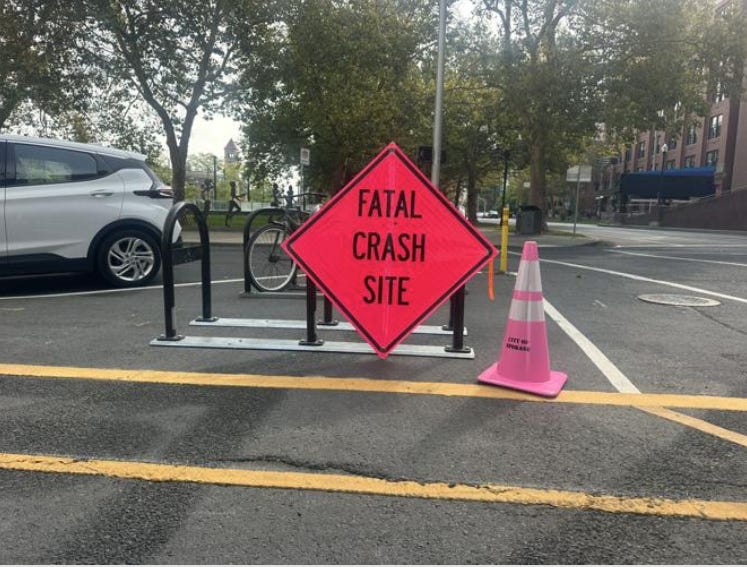
Spokane launches Emergency Streets pilot to combat fatal crashes. ALSO Emergency Streets Pilot Program.
The Emergency Streets Pilot Program is a new initiative that brings temporary traffic-calming measures to the site of a fatal traffic crash within 48–72 hours. Residents and visitors will see highly visible treatments such as cones, speed feedback signs, roadway stenciling, and bright pink signage. The program encourages drivers to slow down while the City monitors traffic speeds and gathers community feedback about the program and traffic safety. These temporary installations (deployments) will remain in place for approximately two weeks as part of the pilot.
Emergency Streets is built on the belief that traffic fatalities are preventable and that immediate action can help reduce the risk of future crashes. The pilot aims to create safer streets, build awareness about the role of speed in traffic safety, and inform future roadway safety improvements across Spokane. Fatal traffic crashes will be evaluated by the Traffic Fatality Review team, a multidisciplinary interagency group led by the City of Spokane Division of Transportation and Sustainability.
India’s Homegrown EV Revolution (Gift Link)
Bloccati nel traffico, cambiare corsia conviene? | Fleet Magazine1
Why Changing Lanes Is of Little Use
The same principle helps us understand what happens when, in an already congested situation, we continually move from one lane to another. Each lane change alters the space between vehicles: the car that enters can prompt oncoming traffic to slow down to re-establish an adequate distance. With light traffic, the effect is easily absorbed; near congestion, however, even a modest braking effort can spread to the following vehicles. This doesn’t mean that changing lanes is always useless. It’s necessary to overtake, take an exit, merge, or negotiate a narrowing. It’s a different matter to do it repeatedly simply because the next lane appears to be moving faster at that moment.
Yang Gao and David Levinson of the University of Sydney measured this phenomenon in real-world traffic. In a study published in 2023 in Communications in Transportation Research, the two researchers analyzed vehicle trajectories on Sydney’s M1 motorway.
Under most conditions observed, lane changes did not produce a significant speed advantage. However, a benefit did emerge in the 45 to 50 km/h range. The study also found a reciprocal relationship between congestion and the frequency of lane changes: heavy traffic pushes drivers to change lanes more frequently, and increased lane-changing activity can, in turn, contribute to worsening traffic flow. The difference between two lanes, after all, can last only a few seconds. One lane moves forward, then slows; the adjacent lane catches up shortly thereafter. Those who continue to move therefore risk chasing a temporary advantage.
Amusements
The Etymology of Cars [Video]
Walking Men Worldwide: pedestrian traffic signals from around the world.
LimeBike Sculpture, Sydney. I assure you I didn’t do this. LimeBikes are heavy.
Financing
AVs
Academia
Seeing Like a Gardener: A New Framework for the Public Funding of Science.
Could AI Be Better at Peer Review Than Humans? [Yes, no doubt] (free article, but registration required).
Press
New Bus Routes, More Rail Services Dominate Inner West Council Transport Plan [report]
More detail needed – expert David Levinson is Professor of Transport at the University of Sydney School of Civil Engineering. He noted that “all of these things are fine to want, but it is not very visionary,” and the council’s vision lacks detail.
“They punted on asking for light rail on Parramatta Road, rather than say, envisioning buses now, including bus lanes and traffic signal priority for buses, and light rail later. Same with Victoria Road, they should have called for light rail. It is not like they are paying for it, but they seem to be conceding the case before asking for what they want.”
“They missed an opportunity to call for lower speed limits on streets in residential and commercial areas and around schools, and other traffic-calming and pedestrian improvements to make it easier and safer to walk around for transport, not just recreation.”
“Buses on WestConnex is good, and it was promised by the proponents of WestConnex when it was approved. Councils should not have to ask for things that were already committed.”
‘Crushed’: Push to punish hoons with loud cars
David Levenson [sic], a professor of transport engineering at the University of Sydney, said loud vehicles were “a serious issue” that drive down property prices.
“People who have houses on noisy streets don’t find that they can sell those houses for as much as people who have house on otherwise quiet streets.”
“And so, every unit increase in decibels results in about a 0.62 per cent decrease in the price of a house.”

Perché cambiare corsia serve poco
Lo stesso principio aiuta a capire che cosa accade quando, in una situazione già congestionata, si passa continuamente da una fila all’altra. Ogni cambio di corsia modifica gli spazi tra i veicoli: l’auto che si inserisce può indurre chi sopraggiunge a rallentare per ristabilire una distanza adeguata. Con poco traffico l’effetto viene assorbito facilmente; vicino alla saturazione, invece, anche una frenata modesta può propagarsi alle vetture successive. Questo non significa che cambiare corsia sia sempre inutile. È necessario per sorpassare, prendere un’uscita, immettersi o affrontare un restringimento. Diverso è farlo ripetutamente soltanto perché la fila accanto, in quel momento, sembra procedere più velocemente.
A misurare il fenomeno nel traffico reale sono stati Yang Gao e David Levinson, della University of Sydney. In uno studio pubblicato nel 2023 su Communications in Transportation Research, i due ricercatori hanno analizzato le traiettorie dei veicoli sulla M1 di Sydney.
Nella maggior parte delle condizioni osservate, il cambio di corsia non produceva un vantaggio significativo in termini di velocità. Un beneficio emergeva invece nella fascia compresa tra 45 e 50 km/h. Lo studio ha inoltre rilevato una relazione reciproca tra congestione e frequenza dei cambi di corsia: il traffico intenso spinge gli automobilisti a cambiare fila più spesso e, a sua volta, una maggiore attività di cambio corsia può contribuire a peggiorare le condizioni del flusso. La differenza tra due file, del resto, può durare pochi secondi. Una corsia avanza, poi rallenta; quella accanto recupera poco dopo. Chi continua a spostarsi rischia quindi di inseguire un vantaggio temporaneo.