Recently published:
Wang, Z., Ramezani, M. and Levinson, D. (2027) A communication-free decentralised two-dimensional trajectory controller for autonomous vehicles on a lane-free road: A level-k game approach. Transportation Research Part C: Emerging Technologies, Volume 194, January 2027, 105959. [doi]
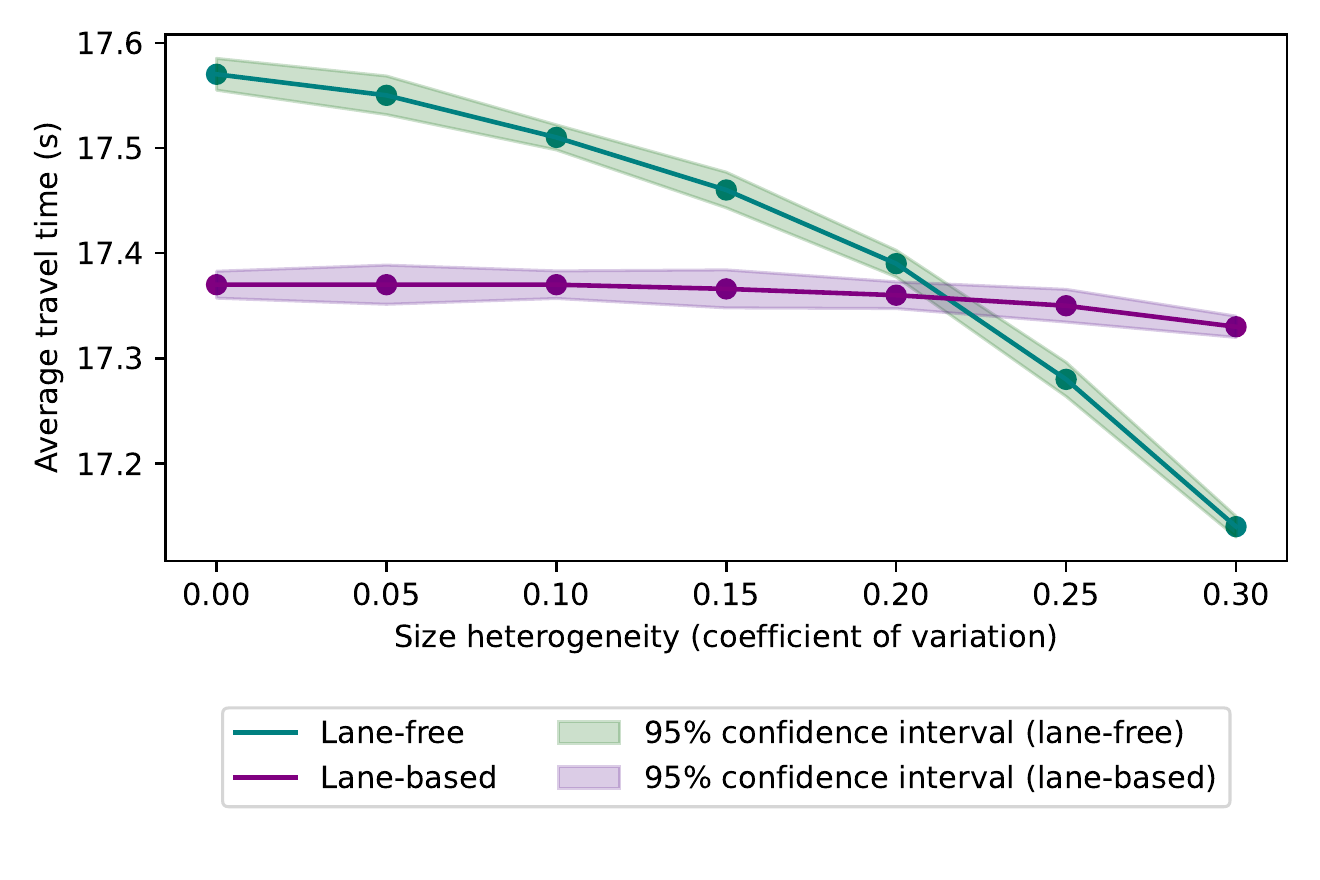
This paper proposes a two-dimensional trajectory controller (2DTC) for autonomous vehicles (AVs) operating on a lane-free freeway. Without relying on inter-vehicle communication, each AV independently determines its acceleration and steering in real time. The 2DTC is formulated as a receding-horizon optimal control problem (OCP) with nonlinear dynamics, costs, and constraints. The OCP is discretized and solved using the continuation/GMRES method to obtain the optimal control values. Strategic interactions between AVs are captured through a level-k game theory model. The performance of the 2DTC is evaluated through both microscopic and macroscopic analyses. Microscopic simulations show that the generated trajectories are smooth and compliant with constraints, while macroscopic measures are used to construct fundamental diagrams, demonstrating capacity levels exceeding those typically reported for human-driven freeway traffic. Further experiments show that higher reasoning depth yields reductions in travel time, while increased vehicle size heterogeneity improves traffic efficiency by enabling more compact packing in lane-free flow. In addition, more homogeneous vehicle speeds tend to result in higher average speed, thereby improving efficiency. Comparisons with a similarly defined lane-based controller reveal that lane-free traffic is less efficient when vehicle sizes are uniform but becomes more efficient once size heterogeneity exceeds a critical threshold of roughly 22%.
Keywords:
Automated vehicle, Trajectory planning, Model predictive control, Nonlinear control, Game theory