The Traffic Between Vision Zero and Net Zero
Read any city plan and you will see some version of these ideas, usually on different pages, or at least different paragraphs:
Vision Zero - the goal of eliminating road deaths and serious injuries.
Net Zero - the goal of cutting greenhouse gas emissions and balancing the remaining emissions with removals.
Yet Vision Zero is a Net Zero issue. If people feel unsafe walking or biking, they will walk or bike less — and drive more. Queensland researchers made the case for joining up road safety and environmental policy in 2001. Toronto’s 2024 Vision Zero report makes the link explicit.
Consider the school run. Many parents drive because the walk feels dangerous. The extra cars make the walk more dangerous for the children still doing it.
Sydney’s household travel surveys trace the rise in the share of 5–9-year-olds driven to school. It was 22.8% in 1971, 37.3% in 1981, 53.9% in 1991 and 66.6% in 1999–2003. Among 10–14-year-olds, the share rose from 12% to 48%. For a national benchmark, the Australian School Travel Survey led by Jennifer Kent found that 61% of school trips in 2025 were by car. Even for trips under a kilometre, the figure was 38%.
Less driving makes streets safer
Fewer cars mean fewer opportunities for drivers to hit someone. A two-tonne car travelling at 50 km/h carries the same kinetic energy whether it runs on petrol or a battery. A climate policy that takes some cars off the road also reduces people’s exposure to traffic. A safety policy that lowers the speed of cars reduces emissions.
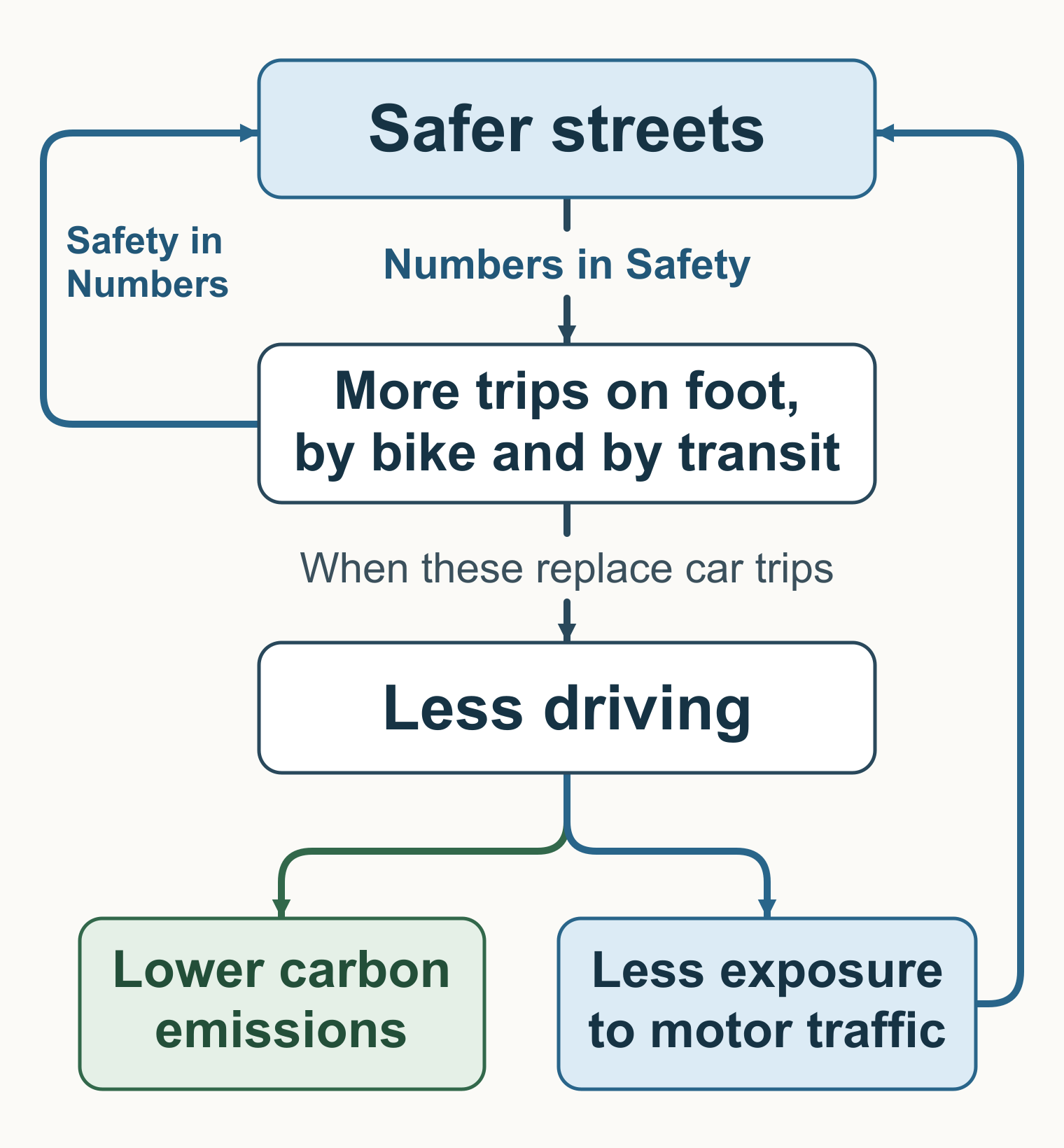
At intersections with more pedestrians, crash risk per pedestrian tends to be lower. That’s Safety in Numbers. Drivers may look more carefully where they expect people to cross. Each person acts as advertisement to drivers that there are more people around.
In Waltham Forest, London, barriers kept through traffic off residential streets. Road injuries inside the neighbourhoods fell to about a third of their previous level relative to comparison areas. A longer Outer London study found the biggest increases in walking and cycling in low-traffic neighbourhoods, with some evidence of less car use or ownership there too.
Safer streets increase active travel
If people perceive travel to be faster, safer, and higher quality, they are more likely to engage in it. We have vast evidence of ‘induced travel demand’ in the transport literature — the more infrastructure that is built and the faster the trip, the more travel that takes place. While induced demand has generally been attributed to reductions in travel time brought about by increases in capacity, I posit this is also due to changes in perceived safety. The harder question is how many people change how they travel because a route feels safer.
That’s Numbers in Safety. At 21 intersections in central Melbourne, an additional fatal or serious-injury pedestrian crash was associated with about 0.7% less foot traffic at that intersection the following year. Some people may have crossed a block away. Others may have changed how they travelled, or avoided a trip altogether.
Safer streets may also attract more people. And lower risk per trip can still leave a city with more total injuries if walking and cycling increase fast enough.
A route to school can be quiet for six blocks and end at one crossing a parent would never cross themselves, much less let a child use alone. In a classic psychology experiment, people’s judgments of an unpleasant experience were shaped by its worst moment and how it ended. People probably judge routes the same way. This implies fixing one bad street crossing could do more to get parents to let their children walk than improving six blocks that already feel safe.
Active travel reduces emissions
Not surprisingly, shifting from cars to walking or cycling is associated with lower estimated travel emissions. Driving fewer kilometres cuts emissions from today’s fleet while cleaner electric vehicles are deployed.
Why system change is so hard
Install a pedestrian crossing and a traffic engineer can calculate how many seconds it will cost drivers. The children whose parents might now let them walk are harder to count. They aren’t in the pedestrian count. They’re in the back seat.
Families have arranged work, school, and shopping, making choices given the options available to them. Over the past century, urban population densities have fallen. Schools have gotten larger, their campuses take more space, and they are more remote from their students. We can fix the pedestrian network and still not solve the land use problem. A safer pedestrian environment can make a walk more tolerable, but cannot bring schools closer.
Blaming a child for crossing or a parent for driving leaves those choices where they were. A Safe System assumes people will make mistakes and limits the harm those mistakes can do. This implies among other things, slower speeds, giving people a longer reaction time to avoid collisions, as well as a lower speed in the unfortunate event of a collision.
Land use is strangely not a pillar in the Safe System repertoire.e, even if the footpath, crossings and bus service sit in different budgets.
FIN
Keep reading with a 7-day free trial
Subscribe to Transportist to keep reading this post and get 7 days of free access to the full post archives.