

You know when you want to say nice things about a project — when you wish it could be a good idea, and you know some of the people working on it, and not all of them are unencumbered by ethics — but you can’t? Because prima facie even those arguing in favour of the project cannot generate a benefit–cost ratio clearly in excess of 1.0, despite heroic assumptions about both benefits and costs?
That’s the Newcastle to Sydney to Western Sydney Airport High Speed Rail proposal.1
It looks primed to receive another quarter of a billion dollars to move from Business Case to “shovel-ready” within two years, assuming the government is re-elected. The highly redacted business case has been released, and the headline number is a benefit–cost ratio somewhere between 0.8 and 1.2.2
A ratio below 1 means costs exceed benefits. A projected ratio barely above 1 means everything has to go right. Everything rarely goes right.
Tunnels
The line requires about 115 kilometres of tunnelling.
It is not surprising that it would be expensive (about 1.8 times to 2.3 times more expensive per kilometre than the section of California’s high-speed rail project currently under construction) as high-speed rail projects go. A lot of it is mountain tunnelling, and tunnelling is classically more costly than building at-grade or elevated segments. That is before geology, contractor claims, delays, and optimism bias do their work.
The costs are estimated assuming everything goes right. The timelines are estimated assuming everything goes right. They build in a little fudge factor, but very few of these projects come in on time and on budget.
We do not need to speculate wildly. We have recent Australian examples of large underground projects evolving once construction begins. The examples of the failure to fully understand what was going on underground include the recent M6 and Snowy 2 cost blowouts.
If the project were overwhelmingly economically compelling, perhaps that risk would be tolerable. When the benefit–cost ratio struggles to clear 1 under favourable assumptions, prudence would suggest caution.
Scale and Gravity
The obsession with the one-hour Newcastle–Sydney trip is revealing. Is the main market in this region really Newcastle to Sydney? Or is it Greater Sydney to Greater Sydney, with Newcastle as an extension?
We all run gravity models in our heads. Interaction depends on mass and distance. There is simply insufficient economic mass in Newcastle for this to be financially transformative on its own.
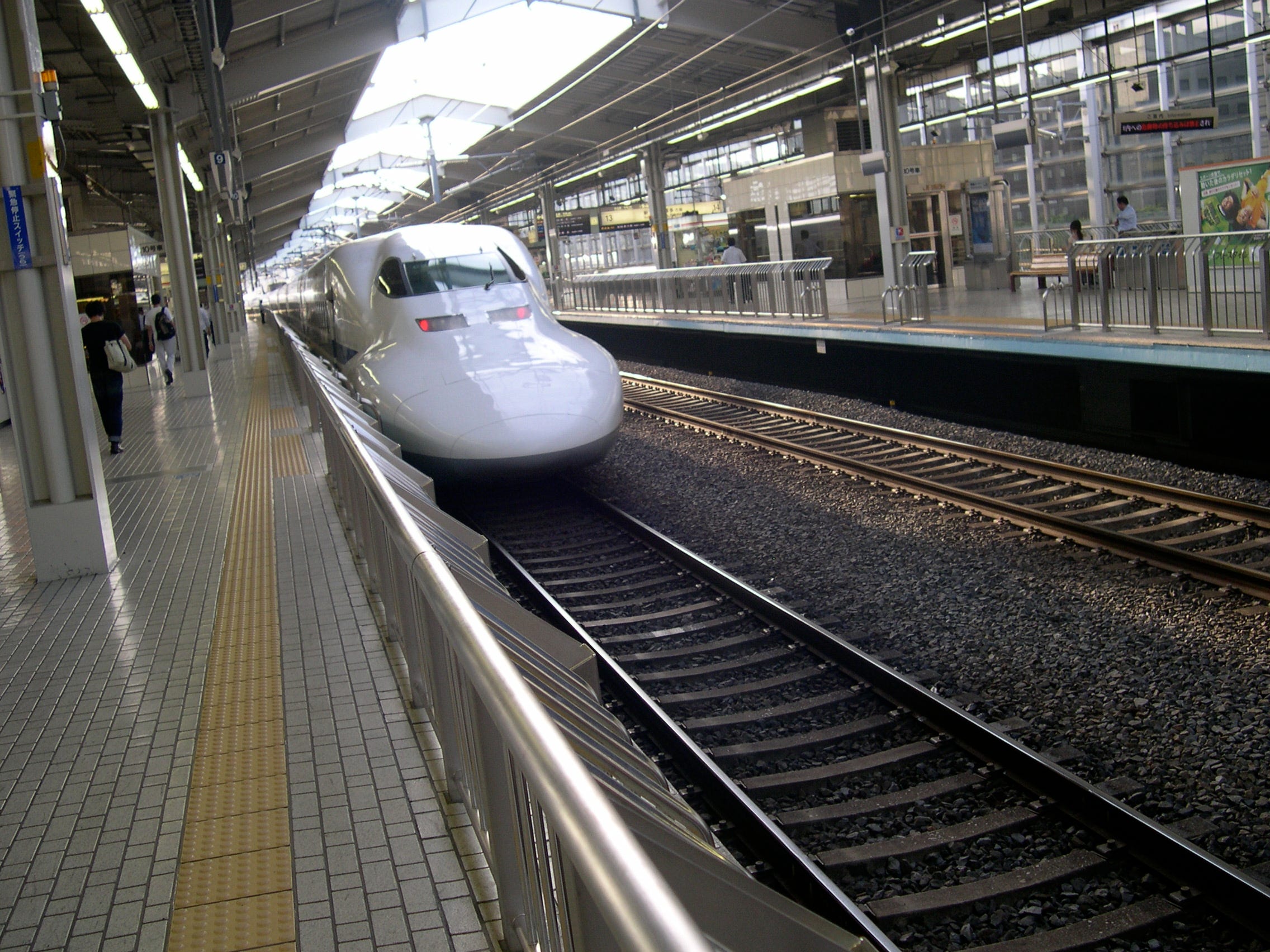
Australia has too few mid-sized cities, so Newcastle seems larger than it is and rises in the imagination of New South Wales-based politicians. But high-speed rail globally works best in corridors linking very large metropolitan regions with strong intermediate markets: Tokyo–Osaka, Paris–Lyon, Beijing–Shanghai.
There is a serious risk that in a decade or two, the line just fails economically.3 All transit services have a virtuous circle/vicious circle problem. More riders leads to increased frequency of service, which makes the line more attractive, which leads to more services. But in reverse, it’s the death of transit. This happens more widely than is acknowledged by proponents. And while, to its credit, Australia subsidised fairly frequent train and bus services through the pandemic, ridership still has not recovered four years on, and the amount of farebox subsidy has continued to increase. There is no guarantee those subsidies will remain if economic conditions change, which inevitably they will.
The Alignment Question
The High Speed Rail Authority has already decided on an alignment that skips Hornsby, Epping, and Olympic Park.
Why build a Metro if you are not going to connect it to further destinations? No one actually wants to go only to Central Station, which is far to the east of the region’s population center. People want to go to where the other peope are. Cities are spaces not points.
If for engineering reasons, the line were running under the North Shore say, instead of the current rail alignment, one might at least ask whether stops at Dee Why or Manly would aggregate commuter demand. The current alignment appears to chase the one-hour headline travel time (each stop adds a bit of time for those on-board with deceleration, alighting, boarding, and acceleration) while foregoing providing express commuter services that could serve intermediate markets.
High-speed rail succeeds when it aggregates demand. Skipping nodes shrinks the catchment.
This pattern is not unfamiliar. There is a similar logic visible in Sydney Metro West, focusing on Parramatta to Sydney rather than the places in between.
Note that the current (presumably interim) terminus would be Western Sydney Airport. This is one more attempt “to make fetch happen”. This is one of the seemingly bottomless pit of infrastructure investments to develop Western Sydney, the new Airport ($AU11B), the new Western Sydney Airport Metro (now $AU13B presumably), and so on. More people want to live in the east of Sydney, but cannot afford to because of development regulations driving up prices. Is it so hard to change words on paper that we must build yet another train to the middle of what is now nowhere.
Fast endpoints look good on press releases. Connected networks move people.
Financial Sustainability
Let us conduct a very simple exercise.
The suggested fare is about $31 for a one-hour journey.4
Suppose 22.7 million riders per year paying that fare. The riders are not all going end-to-end, so this revenue estimate I am about to give is hugely optimistic. Also assume no inflation, and recognise the ridership is from 2061 forward, so it will be lower in earlier years. That yields
$31 trip * $22.7 million/trip * 100 years = $70,370,000,000.
The capital cost is at a minimum over $90,000,000,000.
Even in the best of back-of-the-envelope assumptions, which to be clear I do not believe, passengers will not pay the cost of the system. So the question then is: who will?
So this rail cannot be justified purely on farebox recovery. The case rests on time savings, housing development, agglomeration, emissions reductions. But if, after including those benefits, the ratio still struggles to exceed 1, one must ask how much optimism is embedded in the modelling.
The project has no obvious, robust value capture mechanism in place to close the gap. And one has a hard time seeing the project operator recovering the gap from land development.
Opportunity Cost
The north–south Metro to Western Sydney Airport from St Mary’s to the Aerotropolis is estimated at roughly $11 billion. The airport itself is of similar magnitude.
The market capitalisation of Qantas is in that range ($AU15B as of 2026-02-28). Sydney Airport’s market value ($AU23B) is substantially larger.
The government could, in theory, buy Qantas six times over for the price of one HSR line between Newcastle and Western Sydney Airport. This is a way of illustrating scale. We are deploying capital equivalent to acquiring significant national firms, or four international airports.
The Long Horizon
The future is uncertain.
The World of Tomorrow
What technologies will be available in 15 years? In 50? In 100, the anticipated lifespan of this investment?
Aviation will certainly decarbonise further, and smaller craft may be electric. Remote work may alter commuting patterns permanently. Autonomous vehicles will reshape travel behaviour. Automation not just from AI but from robots will change what we do and how we do it, in ways we cannot anticipate.
Big Australia/Small Australia: Demographics and Immigration
Whether this line is successful also depends on whether Australia continues to grow, which depends on whether Australia continues to permit immigrants. The current government has been at best wobbly about their support for continued immigration, with international students caps and the like being bandied about. The leading opposition in the polls at the moment, Pauline Hanson’s One Nation (PHON) is clearly opposed to more immigration from places where people want to immigrate from. Without immigration, population will quickly begin to decline in Australia as it has in most of the world, where births are lower than replacement rate. That implies less need for new housing or new infrastructure. But the flip side is, if it goes forward, the infrastructure’s thirst for demand will be used to justify higher immigration rates.
Boosters and Hustlers
The HSR crowd should be pleased. There is abundant consulting work. There are authorities to staff, designs to refine, business cases to iterate.
Hustlers will hustle, and boosters will boost.
But at some point, arithmetic intrudes.
If the best case yields a benefit–cost ratio that hovers around 1 under generous assumptions, that is not a compelling endorsement. It is a warning that the margin for error is razor thin.
High-speed rail may one day make sense in Australia. But the economics must lead the enthusiasm, not follow it.
Footnotes
There is no likelihood of a Melbourne to Sydney train any time soon, with stops in Canberra, which might seem to be the corridor of interest.
Infrastructure Australia critique
Minnesotans say they will miss the ‘stress-free’ Northstar as train takes its last ride
“The rail line has struggled to attract riders since its opening and was hit hard by the COVID-19 pandemic when ridership dropped by more than 90%.
Since 2020, fewer than 130,000 riders took the train annually. The line’s highest ridership was in 2017 with nearly 794,000 riders.”
Fares
Rail systems have high fixed costs (trains, tracks, and stations) compared to their operating costs (drivers, guards, electricity) which are spread across many passengers. Buses tend to have lower fixed costs (vehicles) but higher operating costs (drivers and fuel) spread over fewer passengers.
This line will have fares far below costs (perhaps above operating costs, if all the costs are capitalised, but certainly below the cost of financial sustainability)
What is the public policy case for low fares? Is that enough to induce a significant and desirable switch from roads to public transport?
While the saying goes “The straphanger pays the dividend,” clearly this isn’t happening, and HSR is not profitable in the normal sense of the word where interest or availability payments need to be covered by revenue.