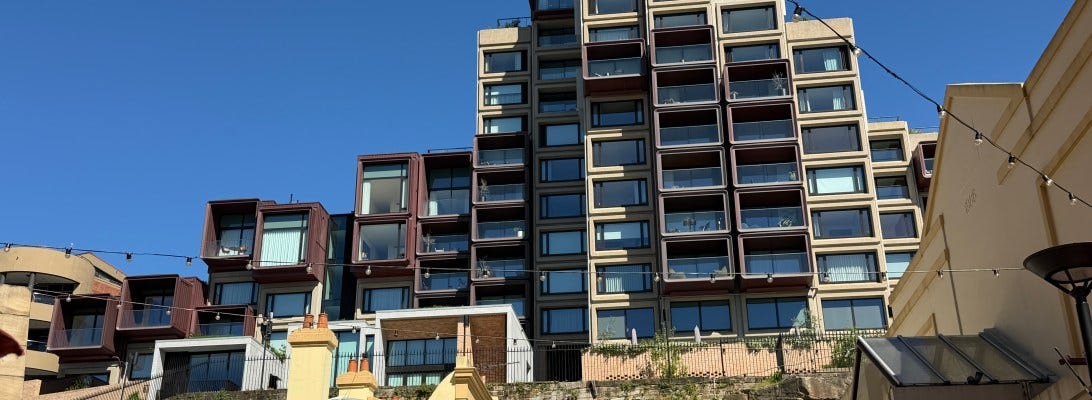
My grandmother and her nine siblings grew up in a two-bedroom apartment. At the peak, twelve people, two bedrooms, six people per bedroom. That is a housing crisis. Maybe your elders lived something like that too. Maybe you do.
Australia today: According to the 2021 Census, Australia had 9,275,217 occupied private dwellings and an average of 3.1 bedrooms per dwelling. Multiply that out and you get about 28.75 million bedrooms in occupied private dwellings, excluding unoccupied dwellings, hotels, etc. The same Census counted 25,422,788 people in Australia (excluding overseas visitors). So we have more bedrooms than people, roughly 1.13 bedrooms per person.
That does not mean everything is fine. It means the problem is not “Australia has no space to sleep”. It is that bedrooms are not conveniently located near jobs, they are not on the market to be rented out, and the ones that are on the market, are priced higher than consumers would like. It is an allocation problem, and an affordability problem.
You can see the long-run drift in the background conditions: Over a century, household size has fallen from 4.5 people per household (1911) to about 2.5 (2021). New houses are still large. In the ABS floor-area series since 2002–03, the average new house sits around the 230–246 m² range, peaking in 2008–09. Our demand for (and supply of) space per capita has increased.
I tend to support the pro-development YIMBY forces (Yes in my backyard), in contrast to the NIMBY movement. We should build more housing, especially in Sydney’s CBDs and Eastern Suburbs, and other job-rich, housing-poor places. This will lower commute times for everyone.
But “build more” runs into two limits that are easy to ignore on a whiteboard.
First, the industry is not a magic tap. Construction employment and labour costs have risen strongly since 2020–21, and the ABS shows that labour-cost growth has outpaced employment growth recently, with strong demand for skilled labour driving wages. NSW’s Productivity Commission review identify “construction industry capacity” and “skills shortages” as supply constraints.
Second, migration both adds demand for homes, and it also adds labour, including in construction. Net overseas migration was 306,000 in 2024–25 (down from 429,000 the year before).
And as a corrective, consider China. Real estate can go from “needed” to “bubble” to “macroeconomic trap”. The IMF describes China’s property downturn as deep and prolonged, with housing starts down sharply relative to pre-pandemic levels. China provides a case study in what happens when a country leans too hard on housing as an engine of growth.
SIX HOUSING CLICHÉS WORTH RETIRING
Below, each “myth” has one source that states the claim (or leans into it), plus two sources that point the other way.
1) Myth: “Building more won’t make housing more affordable.” [source]
Fact: New market-rate supply tends to reduce rents, including in low-income areas, and it does so through both local effects and city-wide “moving [vacancy] chains”. [source]
2) Myth: “Filtering is a fairy tale, new ‘nice’ homes do not help anyone else.” [source]
Fact: Empirical work using address histories and register data finds moving chains that reach middle- and lower-income households and neighbourhoods. [source]:
3) Myth: “Zoning and planning are not really the issue.” [source]
Fact: The RBA estimates a large “zoning wedge” in major cities, meaning prices substantially above marginal supply costs in their framework. [source]
4) Myth: “Upzoning just bids up land, it does not reduce rents.” [source]
Fact: Large-scale zoning reform and staggered upzoning reforms produce more housing and lower (or slower-growing) rents versus counterfactuals. [source] [source]
5) Myth: “New development drives nearby rents up (gentrification beats supply).” [source] (discussing supply skepticism)
Fact: In settings where this can be cleanly studied, the net local effect around new large buildings is often rent decreases, because the supply effect dominates. [source]
6) Myth: “Airbnb exacerbate the housing crisis.” [source] [source]
Fact: Short-term rentals obviously matter a lot in some places (resort communities), but at state or national scale they are typically a small share of the dwelling stock (statistical noise), and by unlocking locked up bedrooms (remember there are more bedrooms than people in Australia), they relieve supply constraints by renting to new residents, transients, temporary workers, as well as tourists. [source][source] The complaint is that they take whole houses off the market, not just bedrooms. In the US, “a 1% increase in Airbnb listings leads to a 0.018% increase in rents and a 0.026% increase in house prices.” [source] They make houses more productive to the owners (who now can earn rent off their asset, and help pay down the mortgage), which drives up prices because it drives up value. Logically, they are also displacing some existing hotel stays and perhaps inducing some demand, creating value. But if we have a hotel-room shortage, we should build more hotels. And if hotels are now less full because of AirBnB, they can lower prices and start attracting some longer-term stays who previously would have been in the short-term rental market.
WHERE THIS LEAVES ME
Australia does not look like my grandmother’s world of six people per bedroom. On the raw stock of bedrooms, we look like a country with enough room and rooms.
The trouble is that rooms are not the same as homes, and homes are not the same as homes near jobs, and homes near jobs are not the same as homes at prices that are affordable at a reasonable fraction of wages.
So yes, build more, especially where the jobs are. Just do not pretend the bottleneck is approvals, or AirBnB, or taxes. Also do not pretend that more supply won’t lower prices.
Yet there remains a construction sector with finite capacity. If more houses are to be built, construction workers need to be more productive, or we need more of them. Robotics aren’t advancing fast enough to increase productivity much in the short term, so we need more workers to build houses faster. And they will come either from overseas or from other domestic industries. And their labor cost will go up if their demand increases.
Notably, if we stop migration, Australia’s population would eventually decline due to low fertility rates. While that might ‘solve’ the raw demand for space, it would leave us with an aging population in large houses and fewer workers to build the infrastructure we need and serve them (us) in our retirement. The solution isn’t fewer people, it’s better alignment between who lives where and where we work.