

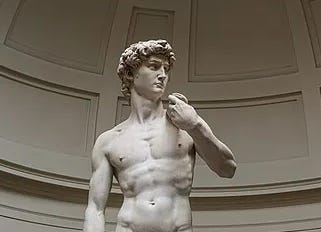
Writing and editing are, ideally, two stages in a complete creative process, yet we often prioritise the act of creation over the art of curation. The process of writing is mostly additive, with authors, starting with a blank page, spending the majority of their time on adding content rather than subtracting. This imbalance leads to verbose texts that obscure the core message, wasting the reader’s time.1.
Drawing from the metaphor of Michelangelo’s David, where the sculptor’s task was to reveal the figure already in the marble, “geological processes” of creation are akin to the writer, while the editor, our Michelangelo, must refine and shape the existing material. Sadly, Geology gets no credit despite having created the marble, and thus David.2 Yet, this editorial role is often undervalued, despite clarifying and distilling ideas for the reader, saving the reader time, lowering their costs of idea acquisition, and increasing their net value.
In the era of large language models (LLMs), which are inherently additive in nature, balancing creation with creative destruction is required to offset tools that flood the market with content quickly. LLMs are unmotivated to subtract,3 which is essential for clarity and impact. This shift from scarcity to abundance in content creation demands a renewed emphasis on curation.
FIN.
"This book should have been an essay. This essay should have been a blog post. This blog post should have been a tweet." — source unknown
Some will credit God, but nevertheless geological forces were required
In general, they are rewarded in training for more text rather than less.