

Transport has always been shaped by intelligence. From horses that knew their routes, through trains following tracks switched to set their paths, to car drivers navigating rush hour, some intelligence, human or otherwise, is integral. Artificial Intelligence (AI) already controls thousands of autonomous vehicles (AVs) and many more semi-autonomous vehicles on the road today without much real-time human intervention or oversight. (Recognising there are tele-operations centres where somebody is watching multiple vehicles at a time, and responding when edge cases arise).
With the advent of Artificial General Intelligence (AGI), the landscape is poised to shift again.1 Some say AGI is already here, and I am sympathetic to the view, given intelligence is a continuum, and many AIs can do many aspects of work faster and higher quality than I can (but obviously not everything, everywhere, yet).
How transport will change in response will be revealed in time.
Some thoughts below:
Automated Everything
Eventually, we would expect AGI to automate all transport modes. Decentralised AGI systems would manage cars, trucks, trains, planes, and ships, automating real-time decision-making, routing, trajectory planning, and control. This reduces the marginal cost of transport by eliminating labor requirements, but may increase capital costs depending on the cost of the new vehicles and systems vs labour.
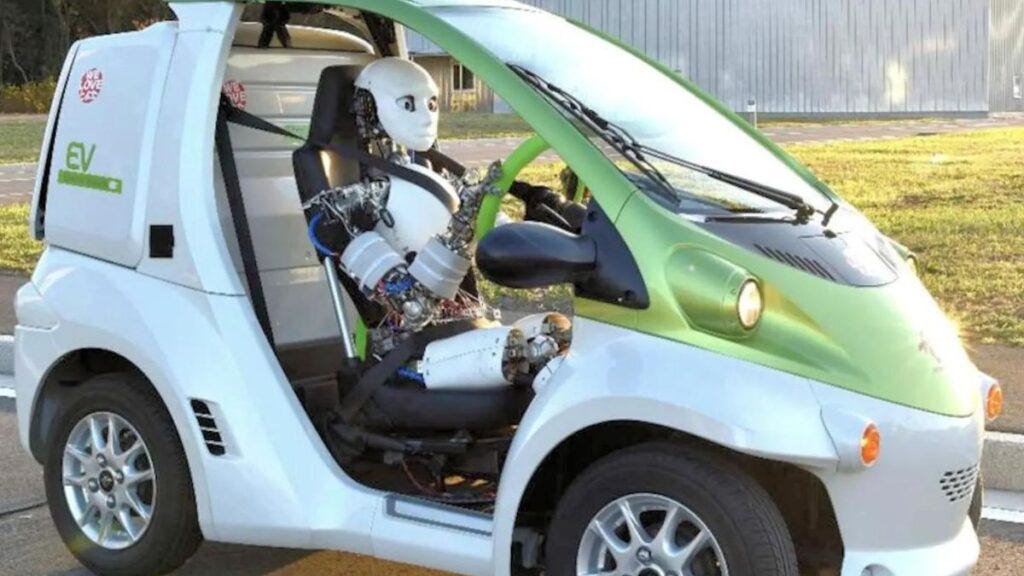
These vehicles are logically robots. But even before we have replaced our entire passenger, commercial, and specialised equipment fleet with in-built AGI, in the short term, humanoid robots (androids) can operate existing human-centric equipment. This might be cheaper than rapidly rebuilding the fleet, as part-time robot operators (who have other functions as well) may come in less expensive than replacing
full vehicles, while still allowing mixed human and robotic operation. This is especially important for capital-heavy specialised vehicles.
Robots serve as backward-compatible solutions, performing tasks in environments not yet designed and optimised for AGI. Over time, more purpose-built systems will be deployed, optimised for AGI from inception, and older human-compatible systems will be deprecated and retired.


Dematerialisation of Demand
If AGI-enabled virtual agents perform many white-collar jobs better and faster than humans, the need for those jobs, and thus daily commuting to, or business travel for, those jobs, should diminish significantly. (Recognising that like lawyers, bureaucracy creates demand for more bureaucracy).
The question arises: what do those put out of work by AGI do?
Traditionally technological innovation has not created permanent mass unemployment, though of course what people do changes: rural mechanisation drove urbanisation, factory automation drove people to offices, and office automation has made everyone a “Director”, or even “Vice President” of something. (I hope to be President of Prompt Engineering (POPE)). Will everyone transition into personal services, trying to stay one career ahead of automation, or will there be massive unemployment because the transition is too rapid? Time will tell, and it depends on the rapidity of the shock.
There are lots of stories about suddenness, (See the 2028 Global Intelligence Crisis by Citrini Research, or AI-2027 by Daniel Kokotajlo et al.), which get attention. But as we have seen with the AV and EV rollouts, physical systems take time to change, so I’d bet on a slower transition than suggested.
Passenger and freight effects may also diverge. Passenger travel, especially commuting and some business travel, could decline. Freight may become more intense if firms run smaller inventories, replenish more frequently, and depend on tighter logistics. Goods still have to move, even if some people do not.
New Risks
Centralizing transport control in AGI systems creates the possibility of widespread failure. Unlike human error, which is typically localized, a single AGI malfunction could affect entire networks simultaneously. This amplifies the need for designing transport systems with robustness and fail-safes as priorities.
If control is centralized or heavily integrated through AGI systems, failures may become more correlated. A bad model, corrupted data, faulty objective function, cyberattack, or software bug could propagate across large parts of the network at once. The system may become more efficient on ordinary days and more brittle on bad ones.
That makes resilience more important, not less. Redundancy, fallback modes, graceful degradation, local override, institutional diversity, and physical slack may become more valuable even as they appear inefficient in a narrowly optimised world. Transport has always needed spare capacity and recovery capability. AGI does not eliminate that requirement, it strengthens it. But designed redundancy and waste should not be confused.
Slack, Reliability, and Coordination
Most transport capacity is wasted much of the time. Seen from the air, roads are mostly pavement rather than vehicle roofs. Zooming into those vehicles, we see most cars carry empty seats, and then, if we watch them over a daily cycle, we see that they sit idle for most of the day. Traffic signals show a green light to empty approaches, while pedestrians impatiently remain standing for six seconds of “Walk” time. Trucks run light or empty on the return leg. Warehouses hold extra inventory because firms do not trust the network. Ships wait outside ports, or straights. Customers pad orders because they do not trust delivery promises. Slack accumulates at every layer because the system is noisy.
Just as large institutions only do something once McKinsey says so, even if their own staff have been screaming about it for years, many people will respond favourably to the recommendations of the AGI even if it’s an obvious solution that’s been waiting around for awhile. The authoritativeness, and general accuracy of AGI (and its successor Artificial Super Intelligence (ASI)) may break through the torpor keeping broken old systems in place.We may finally be able to do all the things we said we should do. A man can dream.
This also changes how to think about schedules. The Great Synchronisation occurred for a reason. Schedules exist because predictability at one layer creates flexibility at another. Railways and airlines both work this way. The visible and inflexible timetable provides a stable coordination device for users, operators, and connecting services allowing the machinery underneath: vehicle assignment, routing, maintenance, recovery, pricing, and staffing to be fluid. Maybe rigidity isn’t going to be as critical a formwork once the system is smart enough and trusted enough.
The Great Synchronisation and The Great Asynchronisation

"The Great Synchronisation" is a shorthand for describing the long historical process of increasingly precise coordination of time and activities. This began with the development of standardised calendars for agriculture. Mechanical clocks, often accompanied by town bells and factory whistles and which enabled the precise measurement, coordination, and…
Revaluing Human Spaces
If AGI leads to a decline in the need for auto-mobility, and especially the use of street space for transport through improved efficiency, particularly through reduced repetitive commuting and routine administrative travel, cities may place more emphasis on proximity and local access. This would not happen everywhere or automatically. Some places may continue to sprawl, especially if less commuting makes distance easier to tolerate. But city streets may be reallocated both between modes, and from transport to non-transport uses, to serve social, recreational, or ecological functions rather than throughput. Reduced movement demand could reshape urban space toward place-centred design. A man can dream.
FIN
Footnotes
AGI refers to machine systems with the ability to understand, learn, and apply knowledge across a wide range of tasks at a level equal to or exceeding that of humans. Unlike narrow AI, which is task-specific, AGI generalises to switch domains, adapt to novel situations, and reason with abstract concepts. For transport, we assume vision-language-action models, where AIs are trained not just on words, but have physical models of the world.
The path from today’s systems to AGI runs through what we might call agentic AI: systems capable of autonomous goal-setting and execution within bounded domains. Today’s AI copilots, assistants, and agents (e.g., route planners, traffic prediction tools) are increasingly competent, but still specialized. As these agents become more capable and interconnected, their domains blur.
Agentic AI evolves into AGI as systems gain broader context understanding, self-direction, and the capacity to reason across tasks. This evolution is not guaranteed, but if achieved, its implications for transport are significant.