

On 19 October I was on ABC Radio’s Breakfast program in Melbourne with Bob Murphy and Richelle Hunt, talking about the toll caps Labor and the Coalition are promising before Victoria’s 28 November election. Tolls are an obvious topic for breakfast radio, since many listeners are driving at the time.
How the Sydney cap works
New South Wales introduced its toll cap in January 2024. Drivers pay the full toll when they travel, and get some returned later as a rebate.
For each e-tag or number plate, Service NSW (an agency, but to most people an app on their phone) refunds weekly (Monday to Sunday) toll spending above a threshold. The threshold was $60 and is $50 until July 2027. Refunds are limited to $350 a week and $5,000 a year.
Only vehicles registered for private use qualify. [i.e. no commercial vehicles]
Drivers link their toll account to a MyServiceNSW account and lodge a claim each quarter. Refunds are not automatic.
By mid-2025 the scheme had returned $139 million to 500,000 motorists, mostly in western Sydney, and another $100 million set aside remains unclaimed. NSW has since made the cap effectively permanent. Under the August 2026 deal with the motorway owners, the operators contribute $75 million over five years, and the state pays the rest, which they probably get back with induced demand from the lower toll prices.1
What Victoria is being offered
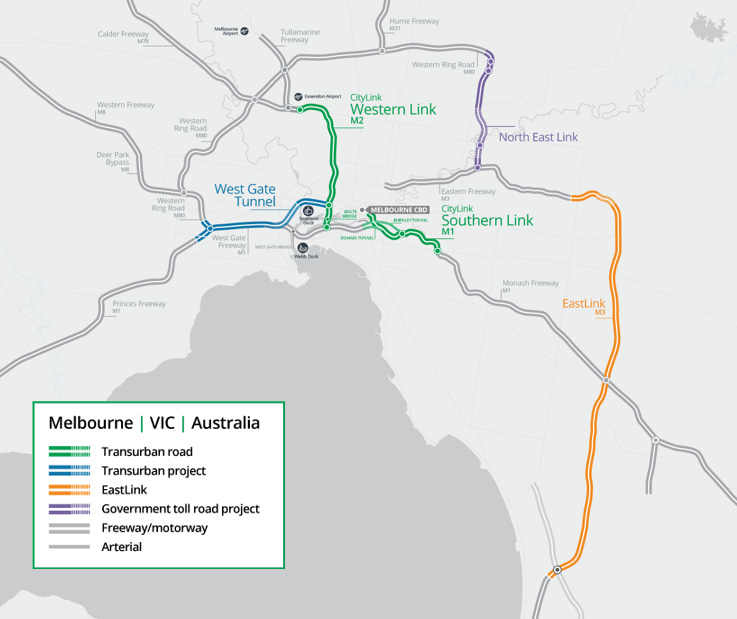
Both parties would copy the Sydney model on CityLink, EastLink and the West Gate Tunnel, with claims lodged through Service Victoria.
Labor: $30 a week, for 2027 only. Cars, utes, vans and motorbikes qualify, including up to five vehicles per small business. Up to $5,000 per vehicle. Labor says about 200,000 account holders would benefit, at a cost of $191 million. It would also cut the $16 fee for paper toll notices to $5.
Coalition: $50 a week for two years from 1 July 2027. Up to $6,000 per vehicle over the two years. The Coalition expects about 100,000 beneficiaries, at a cost of $180 million. Trucks, rideshare vehicles, and fleets of businesses with turnover above $10 million are excluded.
Who pays
The cap subsidises drivers (transponder owners or vehicle owners) with public funds. Transurban (which owns CityLink and the West Gate Tunnel) and the owners of EastLink still receive the full toll. Transurban is owned by its shareholders, and much of that is superannuation funds. If the cap brings more trips onto the motorways, the owners earn more.
The rebate comes from general revenue, so it is paid in part by people who don’t drive, people who drive but don’t use toll roads, and people who can’t afford a car.
A subsidy to driving
Most transport policy aims to reduce vehicle travel, to cut congestion, pollution and crash risk. The toll cap subsidises driving and will increase it overall. Once a driver passes the weekly threshold, additional tolled trips cost them nothing, up to the weekly limit.
Some trips will move from surface streets onto motorways. That is beneficial, since motorways are safer per kilometre and keep through traffic off local streets, but it does not offset the increase in total travel. We have started research on how much additional travel the NSW cap generated, and it is too early to draw conclusions.
It is worth noting there is a similar $50/week cap on public transport fares in Sydney, and a similar cap is being proposed in Victoria. This is different, because we generally, as policy, want to induce public transport use rather than car use. It is not optimal though, as our work on the economic effects shows, and reduces revenue to the transit operator.
Mann, I. and Levinson, D. M. (2026) Fare enough: A quantitative spatial transport model for transit pricing. Transportation Research Part A: Policy and Practice, Volume 214, December 2026, 105237. [doi]
Salience
Victorians would need to remember to claim back through Service Victoria every quarter, which is more (electronic) paperwork to file. The toll operators already know what each tag spends each week, so the rebate could be automatic, but it isn’t, which saves the government (and public) money, permitting politicians to pander to their prospective partisans.
A driver who isn’t paying close attention quarterly might drive more thinking they are capped, and then never claim. In Sydney, $100 million set aside for the scheme was still unclaimed in mid-2025, which suggests many eligible drivers did not claim.
How much behaviour changes depends on how much a driver already spends:
Infrequent users, spending under $30 a week, won’t be affected.
Heavy regular users, mostly commuters already over the threshold, get a kickback but probably won’t change much.
Drivers near the threshold are the most likely to change, adding freeway trips they would otherwise have skipped or taken on another route.
A better fix
In 2025 I am quoted in the Sydney Morning Herald that removing the NSW cap without a replacement would hit low-income households in western Sydney hardest, because they pay a lot in tolls and have few alternatives. I still think so. But the rebate is a patch on a toll system that is regressive to begin with.
A better fix is to change the tolls themselves, through the unified distance-based tolling, such as recommended by the Fels–Cousins Independent Toll Review, which public ownership of the motorways would make possible. (And of course to lower prices in the off-peak and in uncongested areas).
NSW’s August 2026 deal cut tolls modestly on a few roads and left WestConnex, the largest network, out of the price cuts.
Victoria has three toll roads, and North East Link, due in 2028, will be tolled by a state-owned company. That leaves Victoria better placed than NSW to move to consistent, distance-based tolls instead of paying weekly rebates.
Media links:
Labor pledges $30 toll cap as Coalition targets gas ban (ABC, 18 October 2026)
A toll order: Labor and Coalition fight it out over road toll relief for Victorian drivers (Herald Sun, 18 October 2026) [gift link]
Toll price reductions set for multiple Sydney motorways including Lane Cove Tunnel and M2 (ABC, 3 August 2026)
Josh’s toll bill is about to rise 233 per cent. He’s not alone (Sydney Morning Herald, 10 July 2025)
NSW also puts the revenue from inflation-linked increases in Sydney Harbour Bridge and Tunnel tolls into the scheme. Figures for the Victorian proposals come from ABC, Herald Sun and Australian Associated Press (AAP) coverage on 16–18 October 2026. Neither party has published scheme rules.
FIN
[It may look like there is more below, if you pay the toll, but that’s just me hacking Substack’s annoying features, in fact there is nothing below the line. But if you liked this, feel free to pay (i.e. subscribe), it will get posts like this in your inbox if you want, and I’ll use it for a good a cause.]