Recently published:
LEVINSON, D. (2026) Trends in Twin Cities Travel Behavior, 1970–2023. Findings. [doi]
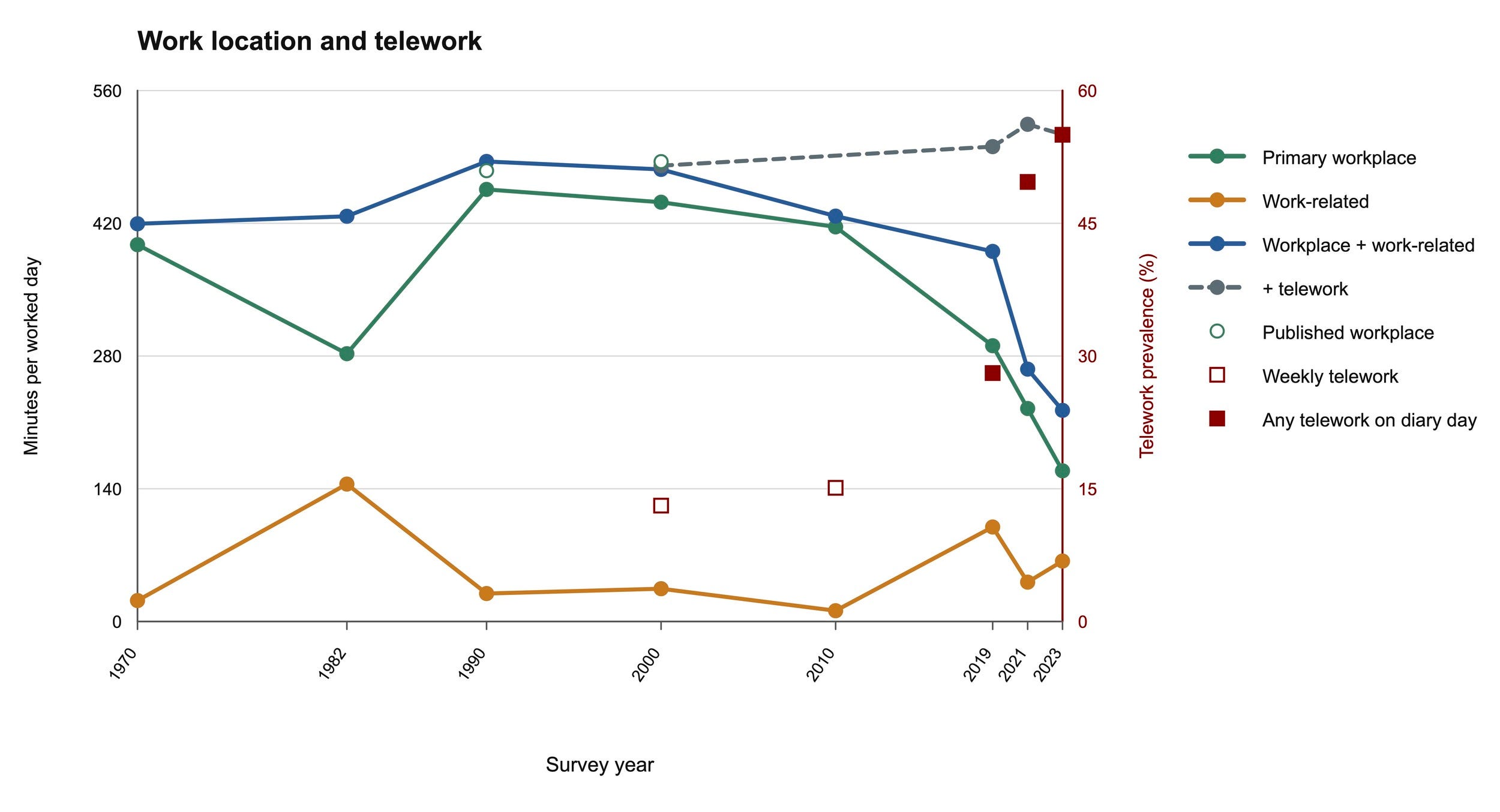
Restoring the Twin Cities Travel Behavior Inventory back to 1970 and extending analysis forward to 2023 changes the long-run interpretation of regional travel behavior. The main behavioral change is a relocation of work within the day. For adults who worked on the diary day, home time rises by 194.5 minutes between 1970 and 2023, daily travel falls by 16.1 minutes, and on-site work falls by 196.9 minutes. Once work-related destinations and observed telework are added back in, however, the modern series is better read as a shift in work location than as a collapse in total work: telework-aware total work reaches 500.9 minutes in 2019 and 513.7 minutes in 2023. A second result concerns commute travel times. The main auto commute series generally rise from 1970 through 2019 and then decline in 2021–2023, so the longer record supports a rise-to-2019 and post-COVID reversal story rather than a simple monotonic increase. The archival recovery of the 1970 survey, the handling of 1982, benchmark checks for 1990–2010, and remaining 2019–2023 comparability issues are documented in the Supplemental Information.