
Pointers
Supply Chains and their aftermath
Panama Canal Traffic Jam Spurs $4 Million Line-Jumping Payment
Explosion at the Panama Canal | Shoreside Gas Tankers Explode & Threaten the Bridge of the Americas
Australia’s Victoria State Extends Public Transport Benefits
Transport Minister Catherine King casts doubt on road user tax over EV uptake concerns
Security
The Dumbest Hack of the Year Exposed a Very Real Problem | WIRED (Crosswalk messages hacked)
Infrastructure
Corruption
Vehicle Automation
Robotaxi outage in China leaves passengers stranded on highways
Norwegian authority approves driverless Karsan e-Atak operation without safety driver
Your regular reminder
Press
… Despite the eventual addition of a metro line, bus routes and an international airport, the risk of mimicking the Leppington debacle lingers over Bradfield.
“New towns ... removed from city centres have a hard time attracting market development,” Sydney University transport professor David Levinson told AAP.
“Firms want to be near other complementary firms. The defining feature of Bradfield is remoteness.”
In a 2024 submission to an inquiry into transport infrastructure around the new airport, Prof Levinson also argued developments such as Bradfield unnecessarily steered funding away from higher priorities.
“Additional infrastructure investments in the absence of changes in demand will not magically make (success) happen, but will drain resources from solving real problems,” he said.
NSW Planning Minister Paul Scully rejected the assertion Bradfield would be a ghost town.
“We know business is interested and they should be,” he told reporters on Tuesday. …
Time will tell as they say.
Full Interview with Reporter …
1. Are the concerns over hasty, unproven development around the airport which you voiced in that submission still relevant? Has the government addressed them?
Not sure what you mean about “hasty, unproven development”. I think I was arguing there was no evidence development was going to materialise in the amounts hoped for and necessary to justify the infrastructure. Development has yet to materialise.
2. Some have questioned whether this development could be a ‘ghost town’ much like nearby Leppington, where the build-and-they-will-come approach didn’t work. Is this a legitimate concern for this project? Is that a likely outcome?
I think it remains a risk. With enough money, the government could subsidise enough development to occur sooner rather than later, but that’s probably not the best use of resources. Bradfield is pretty remote. It is as far from Liverpool CBD as Liverpool is from Sydney.
3. The government wants the development to contain 10,000 new homes and provide 20,000 new jobs. Is this a likely prospect? How long might it take to deliver?
Eventually perhaps, but new towns on Greenfields removed from city centres have a hard time attracting market development. Firms want to be near other complementary firms. The defining feature of Bradfield is remoteness.
4. What are some of the other risks of a development of this kind which concern you?
5. Are there similar projects elsewhere that have worked well or badly? What can we learn from those?
There have been various new town proposals globally. I grew up in one, Columbia, Maryland, https://en.wikipedia.org/wiki/Columbia%2C_Maryland between Baltimore and Washington, DC., which was intended to be the second largest “city” in Maryland. It eventually grew to ~100,000 people as planned by about 2000 (though the Town Centre is still not fully built from an employment perspective, almost 60 years on (the whole town was expected to be completed about 10-15 years after opening in 1967). It didn’t have a high speed metro to St. Mary’s, but it was also closer to two major cities (one of them the US national capital). Most US new towns don’t get that far before falling over. https://en.wikipedia.org/wiki/Albury-Wodonga_Development_Corporation might be instructive
In my submission, I compared Bradfield and Western Sydney Airport in particular to Dulles Airport outside Washington DC, which took decades to become important. Eventually metro Sydney might grow into it, and planning ahead sounds like it makes some sense, but putting resources into something far in advance of it being useful forecloses investing on other opportunities that would have been more meaningful.
6. Is there a better way the government could go about approaching this development?
The sunk cost fallacy should be kept in mind. The internet says: “The sunk cost fallacy is the tendency to continue investing in a decision based on the resources (time, money, or effort) already committed, even when the current costs outweigh the benefits. This cognitive bias can lead to irrational decision-making, as individuals often feel compelled to stick with their past investments rather than reassess the situation based on new information.”
There are many potential useful investments, and it’s not clear why investing there now is the highest priority.
Posts
On "Universality" in Spatial Models

In Cosmos, episode 2, Carl Sagan famously said “Extraordinary claims require extraordinary evidence”.
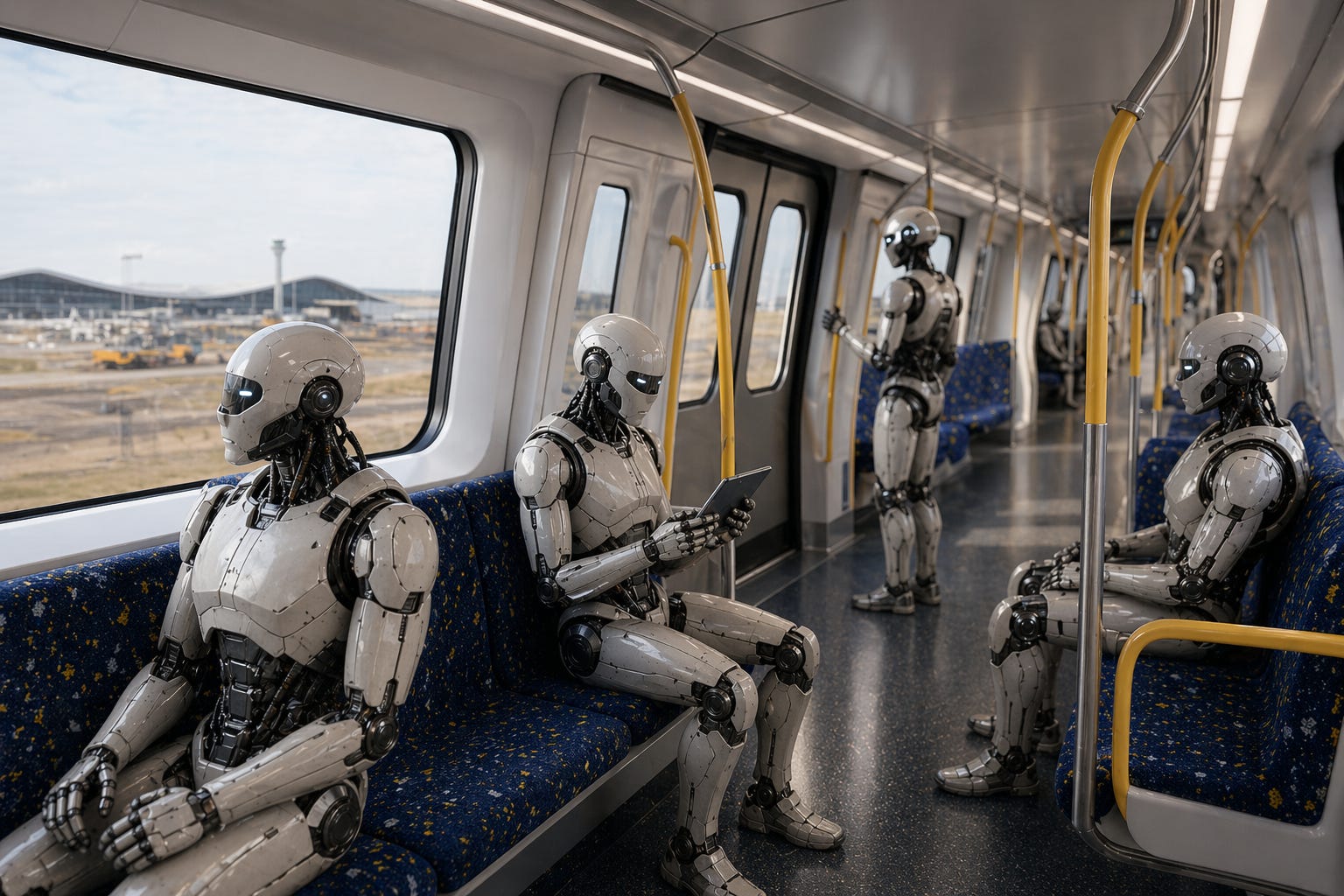
On the Effects of Artificial General Intelligence on Transport

Transport has always been shaped by intelligence. From horses that knew their routes, through trains following tracks switched to set their paths, to car drivers navigating rush hour, some intelligence, human or otherwise, is integral. Artificial Intelligence (AI) already controls thousands of autonomous vehicles (AVs) and many more semi-autonomous vehicles on the road today without much real-time human intervention or oversight. (Recognising there are tele-operations centres where somebody is watching multiple vehicles at a time, and responding when edge cases arise).

Hedonics, Anime, and Database Consumption Theory

Hedonic theory in economics says that some many goods are bundles of attributes. A house is not just a house, it comprises floorspace, bathrooms, access to jobs, school access, noise externalities, lot size, view, parking, and so on. Price reflects the bundle (Rosen 1974). This is not limited to housing, though it is perhaps the most familiar context, and the
Publications


Performances