Recently published:
Jantabadi, F., Ermagun, A., and Levinson, D. (2026) Spatial patterns of access-density mismatch reveal infrastructure gaps and strategic opportunities for new housing. npj Sustainable Mobility and Transport. [doi]
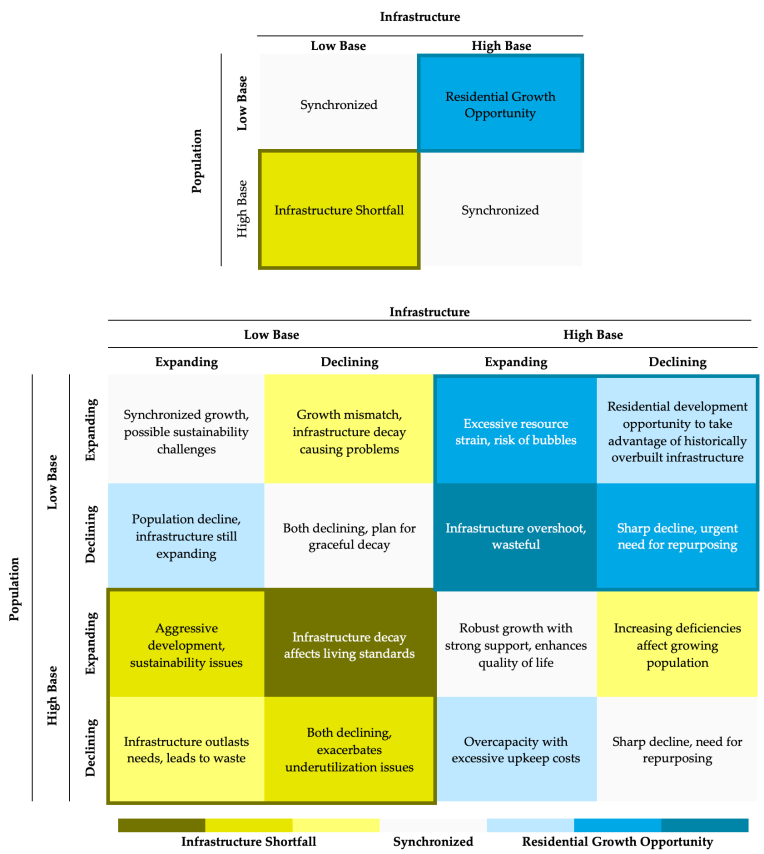
The interaction between regional access to opportunities and local density of residences has been central to questions of urban structure. However, real-world dynamics often diverge from idealized economic models, resulting in an “access-density mismatch.” This mismatch occurs when rapid population growth, inefficient transport systems, or uneven infrastructure investments lead to a disconnect between where people live and the access provided by the transport network. Access-density mismatch manifests in two primary forms: (i) high-density areas with lower-than-expected access, and (ii) low-density areas with higher-than-expected access. Here, theoretical explanations and empirical investigations are conducted to: (i) examine the association between local density (gauged by walk access to population within five minutes) and regional access (gauged by transit and automobile access to employment opportunities within thirty minutes), and (ii) identify the access-density mismatch areas and their potential correlates at the census block level across the fifty most populated metropolitan areas in the United States.
Five insights are identified.
First, a statistically significant positive correlation exists between local density and regional access, with automobile access inducing higher residential density than transit access. A 1% increase in automobile access and transit access is respectively associated with a 0.5% and 0.34% increase in local density at the national level.
Second, more auto-oriented and less centralized metropolitan areas exhibit a weaker association between transit access and residential density.
Third, metropolitan areas where transit access-induced density is above the national average almost invariably exhibit a higher share of transit ridership for commuting.
Fourth, the spatial pattern of automobile access-density mismatch is similar to the spatial pattern of transit access-density mismatch. As one moves away from the central business district, regional access tends to surpass local density. This suggests that the current state of infrastructure can support a higher residential density, and there may be market opportunities for increased residential development.
Fifth, there is a difference in the magnitude of automobile and transit access-density mismatches. In city peripheries, the mismatch is greater for automobiles, with automobile access often exceeding the local density, leading to infrastructure under-utilization. In contrast, in core urban areas, transit access-density mismatch is more pronounced, with transit infrastructure lagging behind local residential density. This disparity reflects historical infrastructure investments, where automobile networks have expanded faster than transit systems, yet have not correspondingly increased residential density.