

Recently published:
Levinson, D. M. (2026) Should I tax or should I trap? Traffic fines, tax exporting, and speed limits. Economics of Transportation, Volume 48, December 2026, 100473. [doi]
A local government that keeps traffic-fine revenue can use speed enforcement to export taxes. The model has one entry point and three traveller groups. Drivers know the posted limit and fine schedule and choose speed and whether to travel. The locality counts resident surplus and crash losses borne locally; a global planner also counts non-resident surplus and losses borne elsewhere. This difference can favour a lower local limit or higher fines, but only when the burden imposed on non-residents outweighs the safety benefit the locality omits. The enforcement condition separates revenue paid by outsiders, savings in tax distortion, local safety benefits, and collection costs. Under stated conditions, more non-resident crossing demand raises enforcement and the share of expenditure financed by fines. Extensions consider stepped fines, restricted speed-limit choices, and temporary information gaps after a limit change. The welfare comparison survives these extensions, although the smooth speed-choice derivatives need not.
Keywords:
Traffic fines; Tax exporting; Speed enforcement; Municipal finance; Speed limits; Road pricing
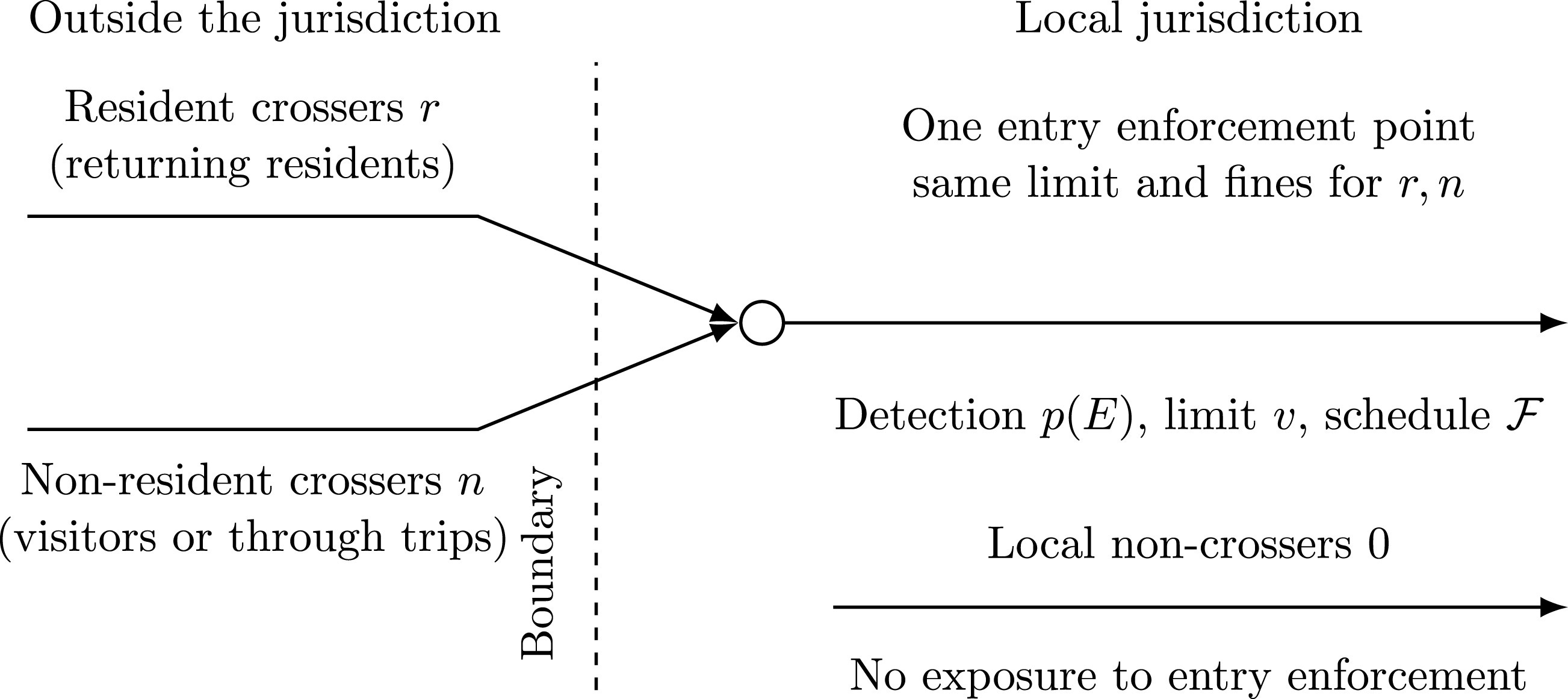
Figure 1. The three traveller groups and their exposure to entry enforcement. The locality counts resident surplus and retains fines from both crossing groups. Crash losses are assigned by who bears them. Source: Levinson (2026), Economics of Transportation 48, 100473. CC BY-NC 4.0.