Recently published
Gao, Yang, Andres Fielbaum, David Levinson (2026) Roadspace Allocation between Autos, Buses, and Bicycles with Heterogeneous Demand. Transportation Research part A. Volume 205, March 2026, 104884. [doi][share]
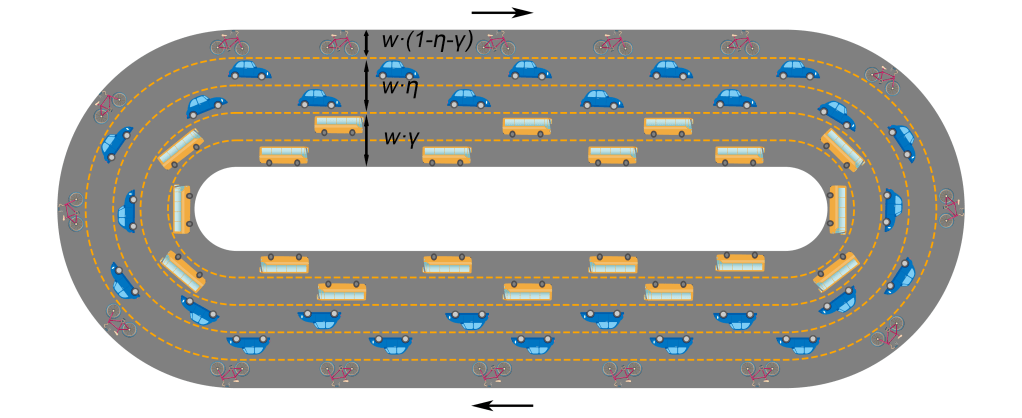
The allocation of road space among different transport modes has long been a key issue in urban planning, yet it lacks solid theoretical foundations. This paper investigates the optimal allocation of road space among three transport modes: private vehicles, buses, and bicycles, for overall system performance. The travel time for each mode is determined based on travel speed derived from fundamental diagrams (FDs). Changes in bus travel time are the least sensitive to excessive demand, as the number of buses is only indirectly affected by demand. A mode choice equilibrium framework based on deterministic user equilibrium is proposed to handle cases with and without heterogeneity in passengers’ waiting time thresholds for buses. Analytical and numerical results reveal that the optimal road space allocation strategy depends on the demand level. Without considering passenger heterogeneity, the optimal strategy is a corner solution — allocating all road space to one of the three transport modes. When heterogeneity is considered, low and medium demand levels result in all space being allocated to private vehicles and bicycles, respectively. For high demand levels, the optimal solution is a non-corner solution, where road space is allocated to both buses and bicycles, and the proportion allocated to buses increases as demand rises. The initial road space share for buses significantly influences system performance. Crucially, this induces either a virtuous or vicious cycle that impacts public transport usage. The threshold for this effect is around 0.4, meaning that allocating approximately half of the road space to buses is critical, and this threshold decreases as demand increases. This study highlights the importance of tailoring road space allocation strategies to demand levels to maximize transport efficiency.