

A walk can be short in metres and long in minutes. The destination may be just across the road, but getting there requires waiting for permission to cross. For someone walking to a bus stop or station, that wait is also part of the public transport trip.
Traffic signals allocate this waiting. While one movement proceeds, a conflicting movement waits. Longer green time for one group imposes delays on another. Deciding how to set the signals therefore requires a choice about whose time to save.
Minimising vehicle delay gives no direct weight to pedestrians. Minimising total person-delay counts everyone, but can still leave pedestrians waiting a long time where vehicle occupants greatly outnumber them. Giving extra weight to pedestrian waiting expresses a different priority: the circumstances of the wait matter as well as the number of minutes.
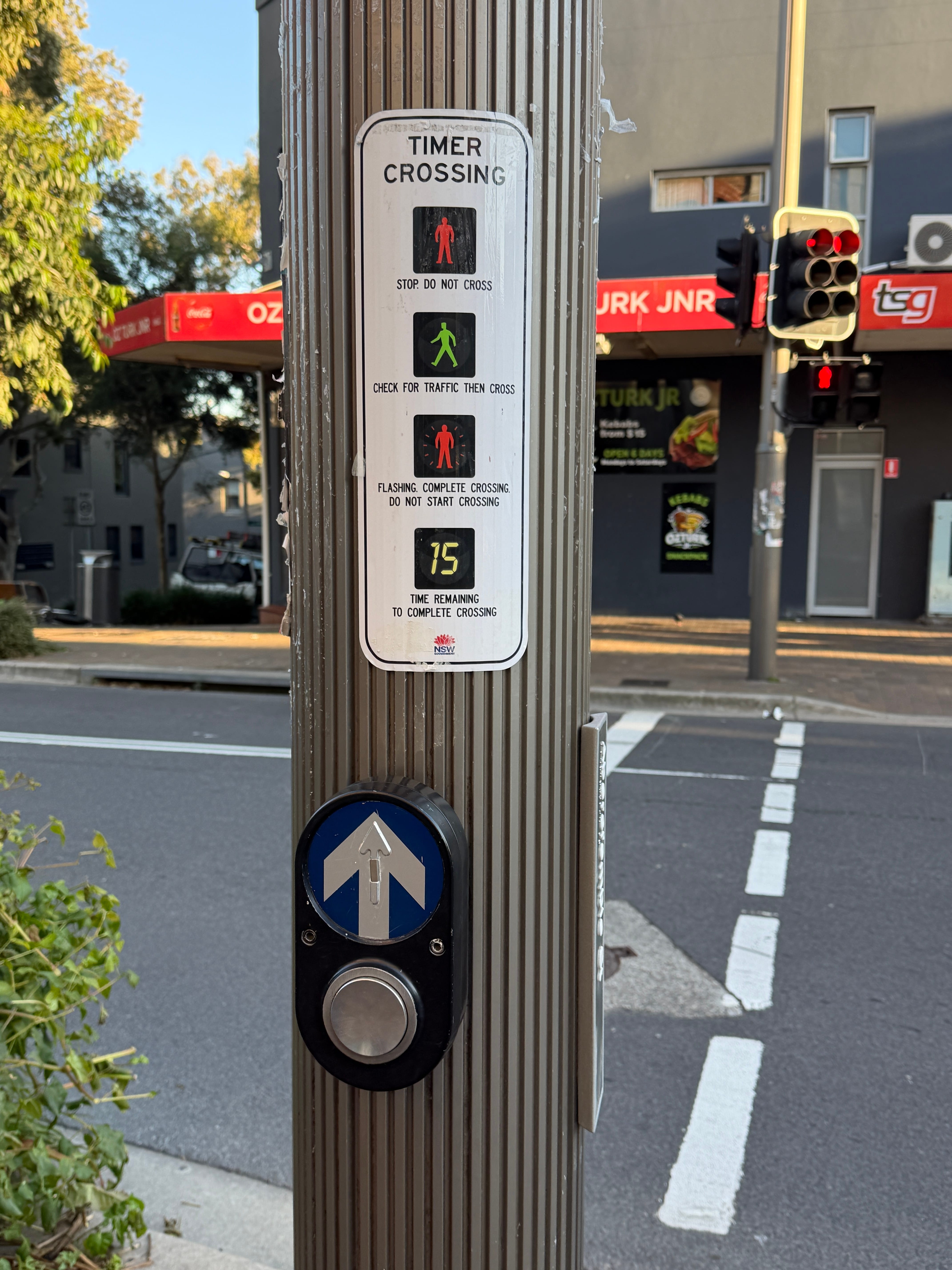
Even making that choice requires better information about pedestrians. Vehicle detectors count passing vehicles. A pedestrian button (actuator) usually records the first request for Walk, leaving subsequent arrivals uncounted. One person and a queue of people can generate the same request.
In a 2019 blog post I suggested that the time to the first button press offers a way to estimate those missing arrivals using data that is already collected by the agency managing traffic signals. At a busy corner, the next person generally arrives sooner than at a quiet one.
I have just finished a trilogy of short peer-reviewed papers in Findings implementing this idea.
Levinson, David. 2026. “Testing Pedestrian Flow and Delay Estimation from First-Actuation Latency.” Findings, August 20. https://doi.org/10.32866/001c.166369.
Levinson, David M. 2026. “Estimating Pedestrian Flows and Signal Delay from Sydney Traffic-Signal Event Histories.” Findings, October 20. https://doi.org/10.32866/001c.172160.
Levinson, David M. 2026. “Whose Time Do Traffic Signals Save? Pedestrian–Vehicle Delay Tradeoffs Across Sydney Intersections.” Findings, November 2. https://doi.org/10.32866/001c.172237.
Manual observations and video allow the estimates to be checked and adjusted for groups arriving together and people who don’t press and don’t comply with either Flashing Don’t Walk or Walk Signals. Existing signal records can then tell us more about how many people cross and how long they wait.
For the usable records at 174 Sydney intersections, the estimates for one day amount to about 332,000 crossings and 3,700 pedestrian-hours of waiting if everyone waits for the Walk signal. These are crossings during the observed hours, so a person crossing several roads contributes several times. The delay accumulates along a walking route as well as across the network.
A comparison with vehicle delay at 168 intersections estimates an average pedestrian wait of about 40 seconds per crossing for people waiting for Walk, against about 10 seconds per vehicle. Vehicles pass through about 14 times as often as pedestrians cross. Consequently, giving each vehicle a small additional delay can cost more total time than removing a much longer wait from each pedestrian, if all time were weighted equally, for both the pedestrian breathing in the air of a busy arterial while exposing them to the risk of a wayward vehicle, and for the passenger of a climate-controlled metal box.
To test the cost of pedestrian priority, a modelled timing change aimed to bring Walk forward to within 30 seconds of the first request. Minimum lengths for the preceding signal phase were retained, so that target could not always be met. Across 95 eligible intersections, assuming everyone waits for Walk, the change saves about 440 pedestrian-hours and adds about 886 vehicle-hours.
With equal weights for everyone’s time, the additional delay to vehicle occupants outweighs the pedestrian saving. At an assumed average occupancy of 1.2 people per vehicle, when the weight for pedestrian waiting exceeds 2.42 times the weight of vehicle-occupant waiting, this change comes out ahead across all 95 sites.
At 29 of the 95 intersections, the model reduces delay for both pedestrians and vehicles. Bringing Walk forward can also bring an earlier green for some vehicles. The other 66 intersections trade pedestrian time saved against vehicle delay added.
FIN
There is no paid content below this line.