Recently published:
Hao, W. and Levinson, D. (2026) Estimating mode choice in decentralized shared mobility: A bagging-enhanced heterogeneous ensemble method. Travel Behaviour and Society. 44 (July 2026) 101287. [doi]
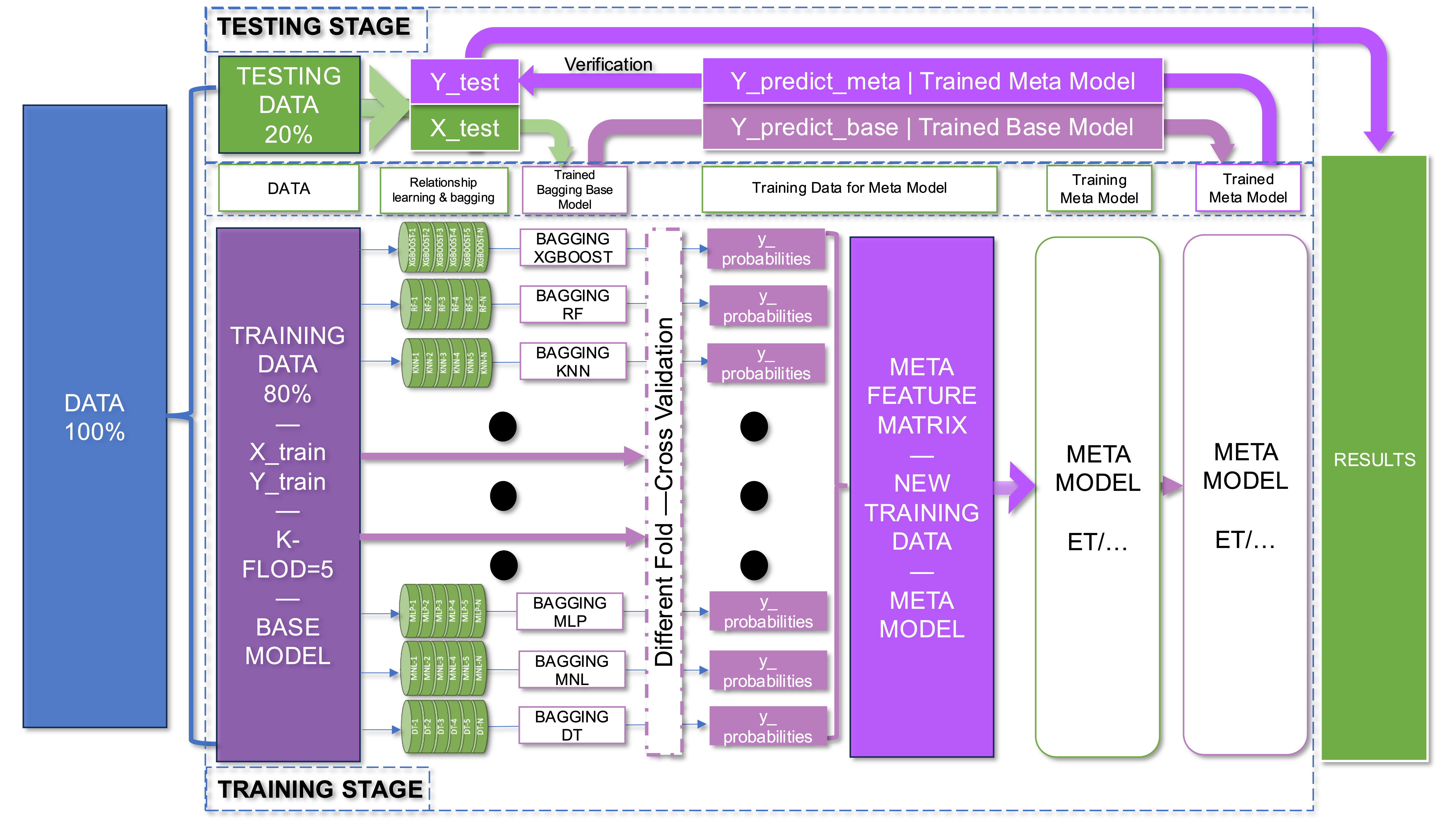
A heterogeneous ensemble method combines multiple models to improve predictive accuracy, robustness, and generalizability compared to any individual model. In this paper, we introduce a novel Bagging-enhanced Stacking Heterogeneous Ensemble Method (BESHEM) designed to capture the complexity and nonlinearity inherent in travel mode choice modeling. BESHEM integrates linear, tree-based, probabilistic, instance-based, and neural network-based models through nested bagging and stacking strategies, significantly outperforming conventional ensemble methods.
We apply BESHEM to analyze User-organized Pre-pooled Ride-hailing (UPR), an emerging mobility mode among suburban university campuses in China, which combines the flexibility of ride-hailing with the collaborative mechanisms and cost-effectiveness of traditional carpooling. We evaluate and compare BESHEM against twenty representative base models and four established ensemble strategies using a comprehensive dataset from UPR users and non-users, encompassing socioeconomic attributes, travel scenarios, and attitudinal perceptions. After comparing BESHEM with all benchmark ensembles and base models, we find that when the meta-learner is set to Extra Trees, BESHEM achieves the highest prediction accuracy among all competing methods. Feature importance analyses reveal that UPR adoption is positively influenced by previous ride-sharing experience, medium- to long-distance metro-integrated travel scenarios, and perceived safety among female users, while negatively affected by short-distance competitive travel alternatives and privacy concerns.