Recently published:
Askari, S., Tilahun, N. and Levinson, D. (2026) Determinants of automated speed camera location choice. Journal of Transport Geography, Volume 137, December 2026, 104869. [doi]
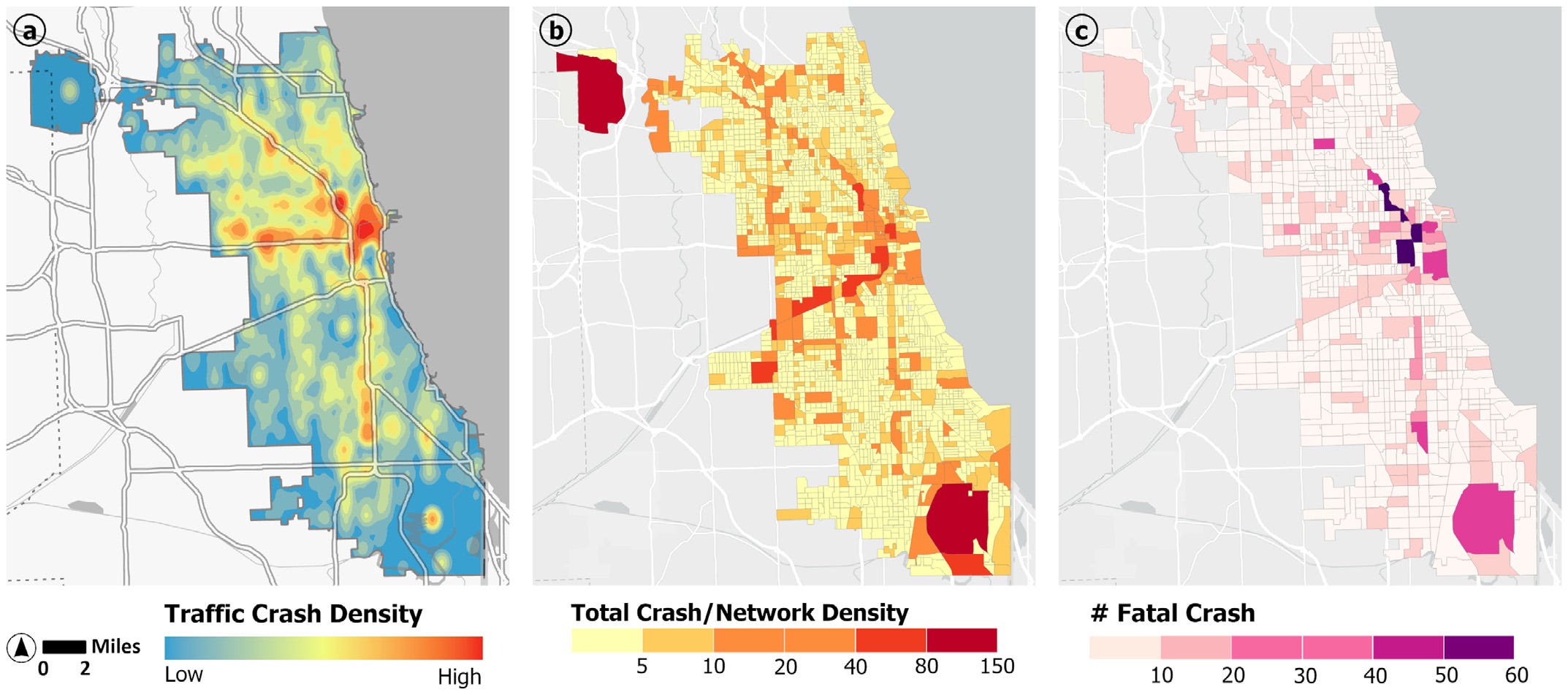
Although speed cameras are widely documented to reduce speeds and improve road safety, less is known about how jurisdictions decide where to place them and whether placement aligns with stated safety and equity goals. This study examines speed camera location decisions in Chicago. We compare selected camera sites with legally eligible but non-selected candidate sites within school and park safety zones, and analyze how crash history, nearby child population share, neighborhood socio-demographics, political engagement, and roadway-user composition are associated with camera placement. Models are estimated using the full eligible-site sample, a propensity-score matched sample, and a stricter caliper-matched sample. The results show that crash history and nearby child population share are the strongest predictors of camera installation. After accounting for these safety-related criteria, camera placement is negatively associated with neighborhood poverty and population density. Tract racial composition is not a robust predictor of camera placement, while roadway-user composition and voter turnout show less stable associations across specifications. Overall, the findings suggest that Chicago’s initial speed camera deployment was largely aligned with stated safety criteria. However, the negative association between poverty and camera placement points to a safety-equity tradeoff. Municipalities should ensure that efforts to reduce fine burdens in disadvantaged areas do not leave high-risk locations without other safety interventions.
Keywords:
Automated traffic enforcement, Speed camera, Camera site selection, Propensity score matching, Safety