Recently published:
Shaer, Amin, Fielbaum, Andres, and Levinson, David (2026) Detecting Dangerous Driving via Computer Vision: Linking Video-Based Indicators to Road Crashes. Journal of Transportation Safety and Security. [accepted and in press] [doi]
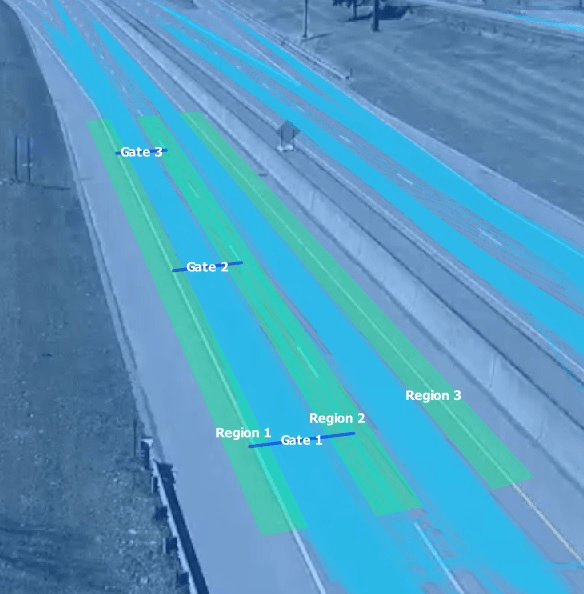
This study demonstrates the potential of combining computer vision with regular traffic cameras for detecting dangerous driving behaviors (DDB). We combine data extracted from 258 h of traffic camera footage across Minnesota with road crash records from 2016–2022. Using computer vision, we identify Dangerous Driving Behavior Indicators (DDBIs), including speeding, short headway, and lane violations—alongside traffic flow, truck counts, and time-to-collision (TTC) metrics. These indicators are analyzed individually and jointly to detect aggressive driving and compound aggressive driving behaviors. An Ordinary Least Squares (OLS) model examines the relationship between DDBIs and the number of instances where TTC falls below two seconds (NTTC2). A Negative Binomial Regression (NBR) model then links NTTC2 to crash frequency, while Structural Equation Modeling (SEM) explores the broader pathways through which behavioral factors contribute to crash risk. Results show that short headway, speeding, and aggressive driving increase NTTC2, which in turn is positively associated with crashes. These findings suggest that video-based behavior detection can support proactive traffic enforcement and crash prevention.