

Recently published:
Levinson, D. (2026) Braess’s Paradox Implies Reduced Demand. Findings, June 30, 2026. [doi]
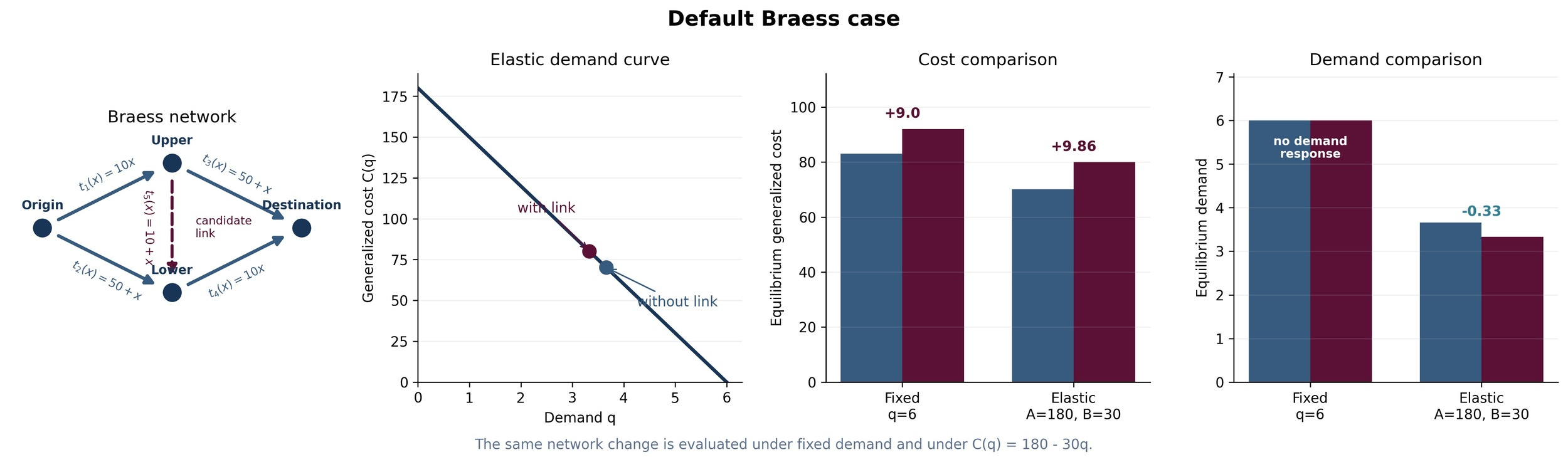
Induced demand is usually interpreted as additional capacity reducing generalized cost and producing more travel. When a network exhibits Braess’s paradox, an added link raises user-equilibrium cost, and we would thus expect demand to fall. I show this in Braess’s original four-node numerical network with linear link costs and inverse demand. In the default case, the added link raises elastic equilibrium cost from 70.14 to 80.00 and reduces demand from 3.66 to 3.33. The reported 143-point sweep maps the Braess region in inverse-demand space; no sign-inconsistent cells appear. The accompanying browser implementation reproduces the reported comparison and sweep.
See also:
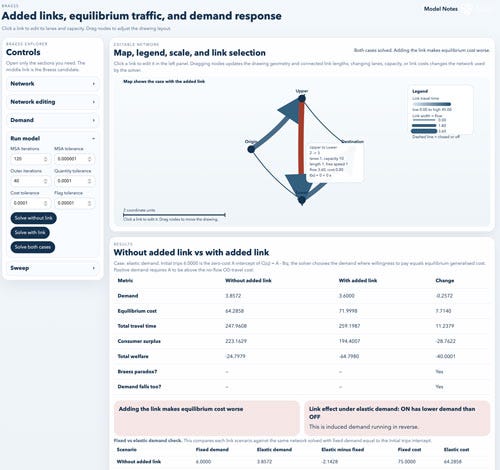
BRAESS– Braess Paradox Explorer
BRAESS demonstrates fixed-demand and elastic-demand user equilibrium on a small editable network.
More >