Recently published:
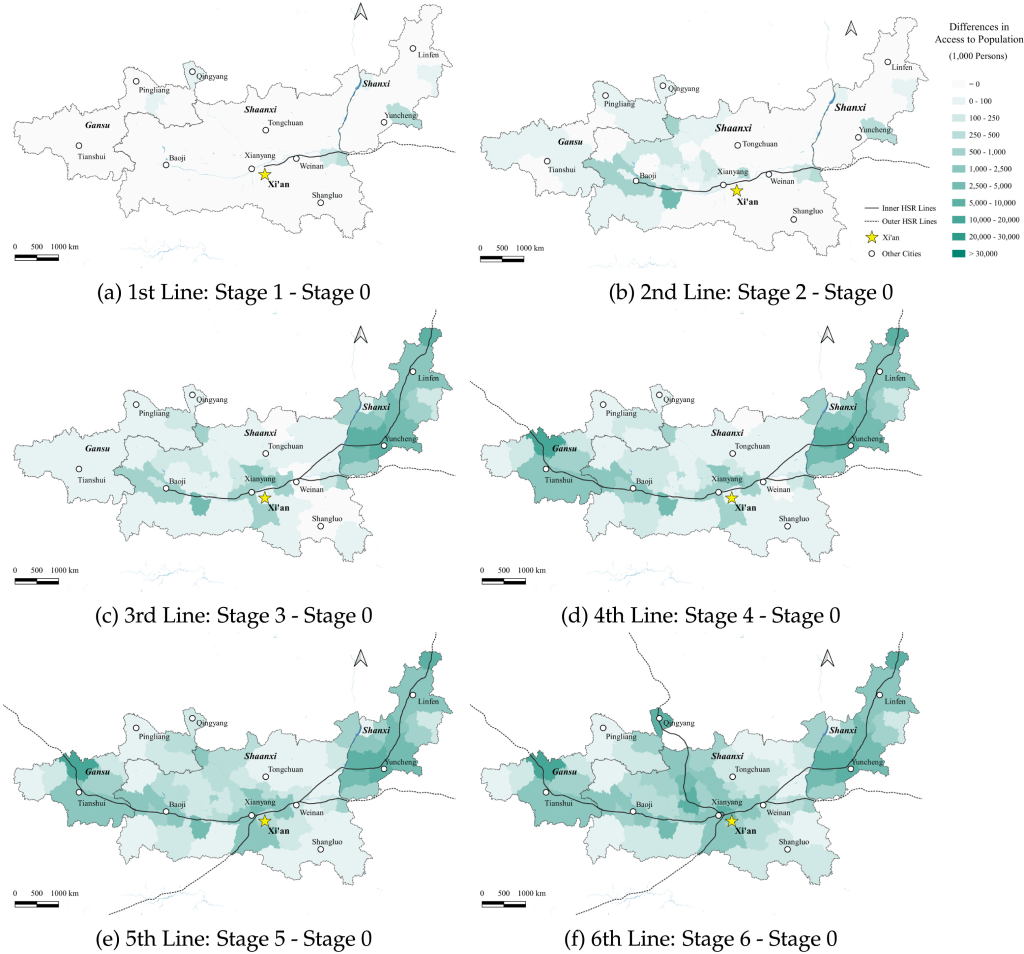
Cui, Mengying, Lijie Yu, Zhe Dai, Ang Ji, Keyue Liu, David Levinson (2026) Accessibility Dynamics with High-speed Railway Network Expansion: A Line-specific, Granular Analysis. Travel Behaviour and Society. Volume 43, April 2026, 101239 [doi][share]
HIGHLIGHTS
Stepwise accessibility analysis by HSR line reveals distinct network maturity phases.
Line accessibility impact depends more on itself than network sequence.
HSR improves accessibility and equity in Guanzhong Plain Urban Agglomeration.
Findings indicate potential accessibility and equity gains from future HSR expansion.
ABSTRACT
This study conducts a line-based accessibility analysis of high-speed railway (HSR) network expansion in the Guanzhong Plain Urban Agglomeration of China based on a multi-modal inter-city network. We propose an improved accessibility indicator that integrates opportunities and transport networks from neighboring regions, overcoming the artificial inequities inherent in traditional methods that restrict destination and route selections to rigid study area boundaries. The results reveal that the HSR network in the study area is still in the growth phase, with accessibility gains following an S-shaped trajectory, and has not yet reached maturity. Future investments are expected to sustain improvements in accessibility and spatial equity. More importantly, the operational sequence of HSR lines is less significant than their individual contributions to accessibility and equity. This implies few, if any, synergies between the HSR lines and emphasizes the importance of strategic line placement over construction order in fostering efficient and equitable regional connections, particularly in emerging HSR networks.