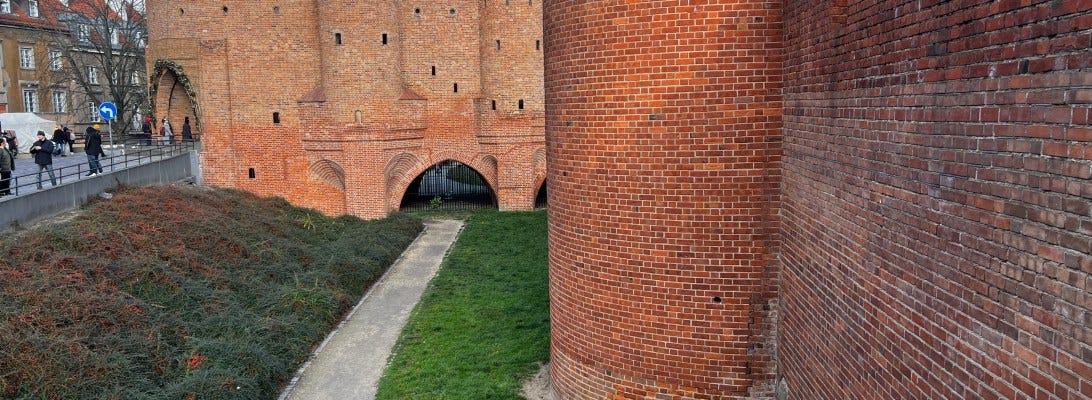
Access is usually about reaching jobs, shops, and schools. It is also about controlling who can reach us. Defensive systems like city walls, fortified gates, patrol roads, satellite networks, and missile shields create access for defence by shifting the balance of movement and information between insiders and outsiders. Inside, people move, see, and act with less friction; outside, the cost and risk of approach rise.
ALONG VS. ACROSS THE BOUNDARY
Defence is directional. Movement within or along a defended line (a wall walk, a patrol road, a radio link) is fast and predictable. Movement across that line is slow and risky. That directional split is the essence of a wall: it is easy to get to any point on the boundary from the inside, hard to cross it from the outside.
This is not a gentle gradient. At the boundary there is a step change. Gates, ditches, fences, and cleared fields of fire raise the normal crossing cost in one step. The more the system concentrates flows into chokepoints, the more a small defending force can monitor, interdict, or delay a much larger one.
DEFENCE IS ALSO INFORMATION
Barriers work better when paired with visibility. Towers once gave sightlines across open ground. Today, radar and satellites stretch that field of view to whole regions. We care not only about range, but also latency (how fast we know), and quality (how often we miss or misread). Better visibility buys time, reduces uncertainty, and turns a static barrier into a responsive system.
False alarms matter here. Too many, and defenders waste effort, fatigue builds, and internal movement slows. The same infrastructure that speeds response can, if noisy, become a drag on daily life.
FROM WALLS TO UMBRELLAS
The wall logic has morphed into a dome in three dimensions.
Satellite monitoring extends the defender’s eyes beyond the border. It turns the outside world into something more legible, so forces and civilians inside can plan with less risk.
Interception networks such as Iron Dome convert detection speed and networked command into local shields. They protect a footprint by intercepting threats in their terminal phase. These systems are powerful, but they can be saturated if many threats arrive at once, or if decoys soak up capacity. Strategic missile defence like Reagan’s “Star Wars” push the same idea outward to boost or midcourse interception, often outside the atmosphere. Whether fielded or not, the design goal is the same: push the defensive boundary farther from the people and assets we care about.
These layers aim to keep ordinary life running. When the chance of harm drops, people enjoy more reliable access to work, school, markets, and each other.
TWO CHANNELS OF PROTECTION
Defence helps in two distinct ways.
Deterrence. Visible barriers, sensors, and chokepoints change attacker behaviour. Some attacks never start. The arrival rate of trouble falls.
Success on contact. If an attack comes anyway, faster movement along the boundary, better visibility, smart chokepoints, and enough interceptor capacity raise the odds of stopping it.
Good systems do both. They lower the number of attempts, then win more of the ones that remain.
THE TRADE-OFFS
Defence is never free. Obviously it needs money to build and maintain. It can also limit openness. But perhaps more significantly, as I once wrote, Security is the enemy of Efficiency. Thick walls can slow trade, air-defence zones can restrict flight paths, and surveillance can erode privacy. Too much friction at the edge can choke off the very access a city or network exists to provide. The design question is not “defend or not,” but how much access (and thus productivity) we lose in order to gain safety.