Recently published:
Yu L., Li, M., Dai, Z., Cui, M., and Levinson, D. (2026) Access door-to-door: An intercity efficiency and distributional analysis of the costs of travel by plane, train, and automobile. Transport Policy. Volume 184, August 2026, 104188 [doi]
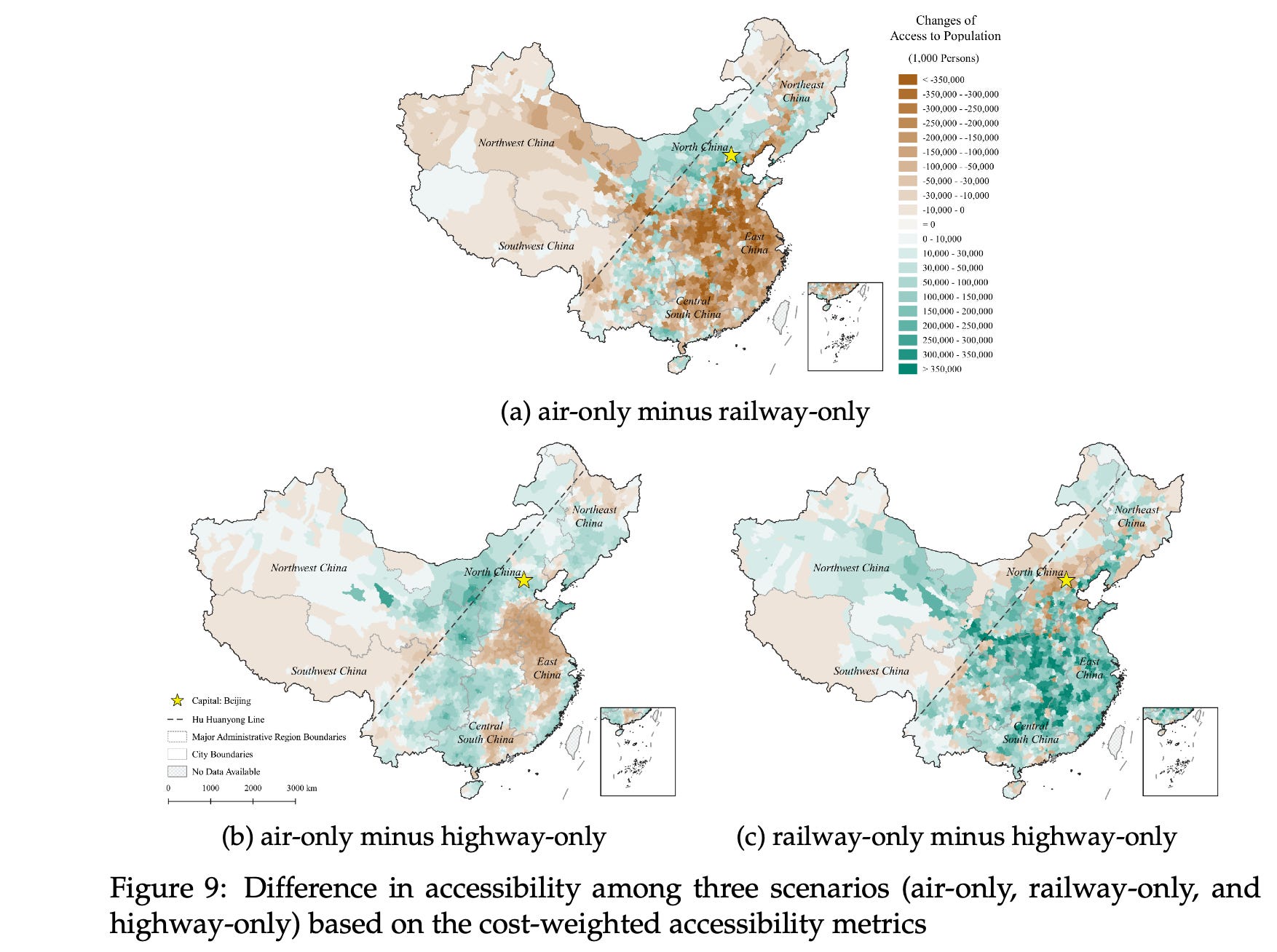
Existing studies typically evaluate air travel accessibility by examining either air network performance or ground access to airports in isolation. This paper offers a complementary perspective by assessing the national air travel accessibility through a door-to-door framework and comparing it against multiple modes of intercity transport. We compare four scenarios: air-only, railway-only, highway-only, and an optimal-mode scenario. The first three rely exclusively on a single mode for intercity trips, whereas the optimal-mode scenario selects the lowest-cost option among air, rail, and direct driving for each origin–destination pair. The results show that air travel provides higher accessibility and more balanced spatial equity than rail or highway travel at higher cost thresholds. Air travel also delivers clear advantages in regions with significant geographical constraints, where land-based transport infrastructure is limited. Although the optimal-mode scenario generally enhances spatial equity, it reduces within-group equity in regions characterized either by highly developed urban cores (e.g., the Yangtze River Delta in East China) or by significant geographic constraints (e.g., the peninsula areas of Northeast China).