Recently published:
Levinson, D., Sarkar, S., Tajik, N. and Ermagun, A. (2026) Access-based network growth: preferential attachment with capacity, cost, and connectivity. Applied Network Science, October 23, 2026. [doi]
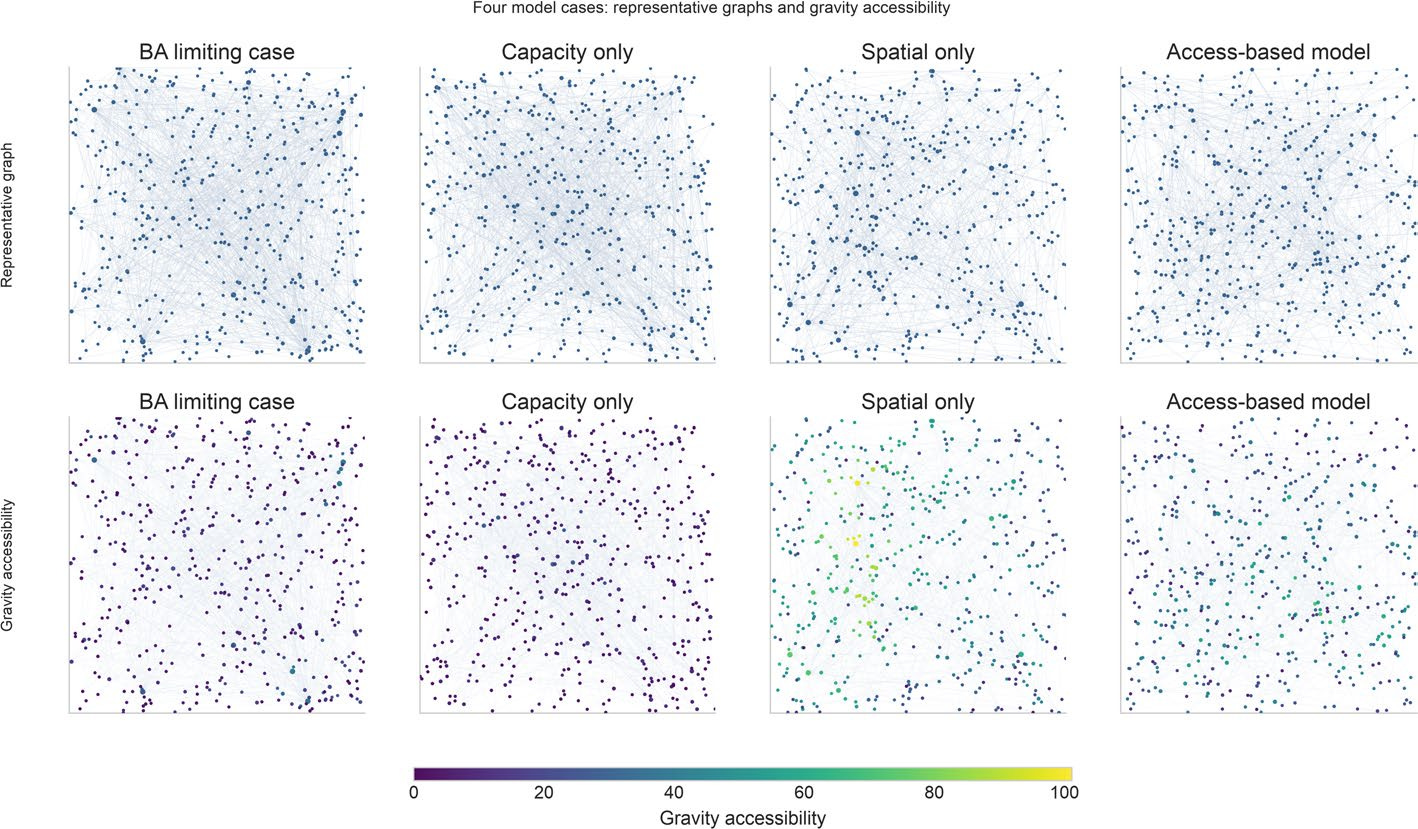
This study proposes a reduced-form, access-based model of network growth in which attachment depends jointly on accumulated connectivity, residual capacity, and origin-destination pair-specific link cost. The kernel contains Barabási-Albert (BA) preferential attachment, spatial attachment, and capacity-limited growth as limiting cases. At N = 1000, α = 1, and κ = 2, the capacity-only specification (β = 1, K = 16) reduces mean maximum degree from 82.31 in the BA limiting case to 16.00, while the spatial-only specification (φ = 1) reduces mean edge length from 0.521 to 0.351. Increasing φ from 0 to 2 shortens mean edge length from 0.526 to 0.157, and increasing κ from 1 to 4 raises clustering and reduces average path length. With mean capacity near 16, integer-uniform and rounded-lognormal capacities raise mean maximum degree to 23.06 and 49.00, respectively. Crossing-handling and access-guided extensions represent junction formation and compare four configured transport-growth strategies using a common ex post access measure. The framework yields directional hypotheses for empirical calibration.
Data/code: https://github.com/dlevinson/attachmentlab-js/tree/main/reproducibility/access-based-network-growth